


 support@epicgifts.org
Table of Contents
- How to Wear Bracelets With a Watch
- Bracelet and Watch Combinations That Work
- Mixing Metals With Watches and Bracelets
- Bracelet Length for Stacking With a Watch
- Styling Personalized Bracelets for Any Occasion
- Protecting Your Watch From Scratches and Wear
- Common Mistakes to Avoid
- Frequently Asked Questions
Last Updated: October 15, 2026
How to Wear Bracelets With a Watch
Wearing personalized bracelets with watches creates a meaningful, layered look, the goal is to let your watch and bracelets complement each other rather than compete.
Wearing personalized bracelets transforms a simple watch into a story. A nameplate bracelet paired with an elegant timepiece becomes a daily reminder of someone you love, the key is layering so both shine.
Your wrist can hold multiple pieces without looking cluttered. The secret: the right wrist, complementary styles, and careful proportions.
Choosing Which Wrist to Wear Bracelets On
Most people wear their watch on their non-dominant wrist, protecting it from daily wear and keeping the dominant wrist free.
If you're right-handed, wear your watch on your left wrist, leaving your right wrist open for bracelets. Left-handed? Reverse that pattern.
Some prefer bracelets on the same wrist as their watch. This works too, with more careful styling.
Pick what feels natural for your wrist and daily routine.
Wearing Bracelets on the Same Wrist as Your Watch
Stacking bracelets on the same wrist as your watch works with a thoughtful approach.
Start with your watch as the anchor piece, typically the bulkiest item, then add one or two bracelets on each side.
A delicate chain bracelet works well next to a watch without competing for visual space.
The main concern is comfort: make sure nothing pinches or shifts when you move. If your wrist feels crowded, move one bracelet to the other wrist.
Bracelet and Watch Combinations That Work
The best combinations respect proportion and create visual harmony. Your watch and bracelets should feel like they belong together.
Balancing Bracelet Size and Watch Proportions
A slim watch pairs well with delicate bracelets like thin chains or beaded strands that don't overwhelm a smaller face.
A chunky watch works with bolder bracelets. A metal cuff or thick braided leather bracelet stands beside a larger watch case without looking mismatched.
The rule: match the visual weight. A substantial watch allows bold bracelets; a minimal watch calls for understated ones.
Consider wrist width too: a thicker wrist carries more visual weight, while a smaller wrist suits delicate pieces.
Selecting Styles: Chain, Cuff, Leather, and Beads
Metal cuffs add polish and structure, working best with watches that have clean, modern lines.
Leather bracelets bring warmth and texture, pairing beautifully with leather watch straps; a braided one adds interest without bulk.
Beaded bracelets introduce color and personality. Gemstone, pearl, and wood beads all add dimension to a minimal watch.
Mix styles: chain plus leather creates texture, while beads plus a metal cuff balance delicate and bold.
Mixing Metals With Watches and Bracelets
Metal tones matter more than you might think: the right combination looks intentional, the wrong one accidental.
Coordinating Bracelet Materials With Your Watch Strap
A stainless steel watch band pairs naturally with silver or white metal bracelets for a cohesive look.
A gold watch pairs with gold or rose gold bracelets.
A leather watch strap opens more options: metal bracelets in any tone work, since the leather grounds the look.
The safest approach: match your watch metal to at least one bracelet, creating an anchor while others vary.
Don't overthink this. Modern style allows mixing metals intentionally. Just make sure it feels deliberate, not random.
Bracelet Length for Stacking With a Watch
Fit is crucial: bracelets that are too tight restrict movement, while too-loose ones slide around uncomfortably.
Measuring and Sizing for Comfort and Movement
You should fit one finger underneath a bracelet, tight enough to stay in place, loose enough to move freely.
When stacking, watch how bracelets sit together: they shouldn't bunch up or create pressure points.
Personalized bracelets with engravings or nameplates need the same care, a slightly looser fit keeps the engraved area from digging into skin.
Test your stack during normal activity; if anything shifts or feels uncomfortable, adjust the fit.
Styling Personalized Bracelets for Any Occasion
Personalized bracelets carry meaning, commemorating relationships, milestones, and moments that matter. But meaning and appropriateness aren't the same thing: the piece that feels perfect on a Saturday morning can feel wrong in a Monday meeting. Style personalization so it reads clearly, fits the setting, and still feels like you.
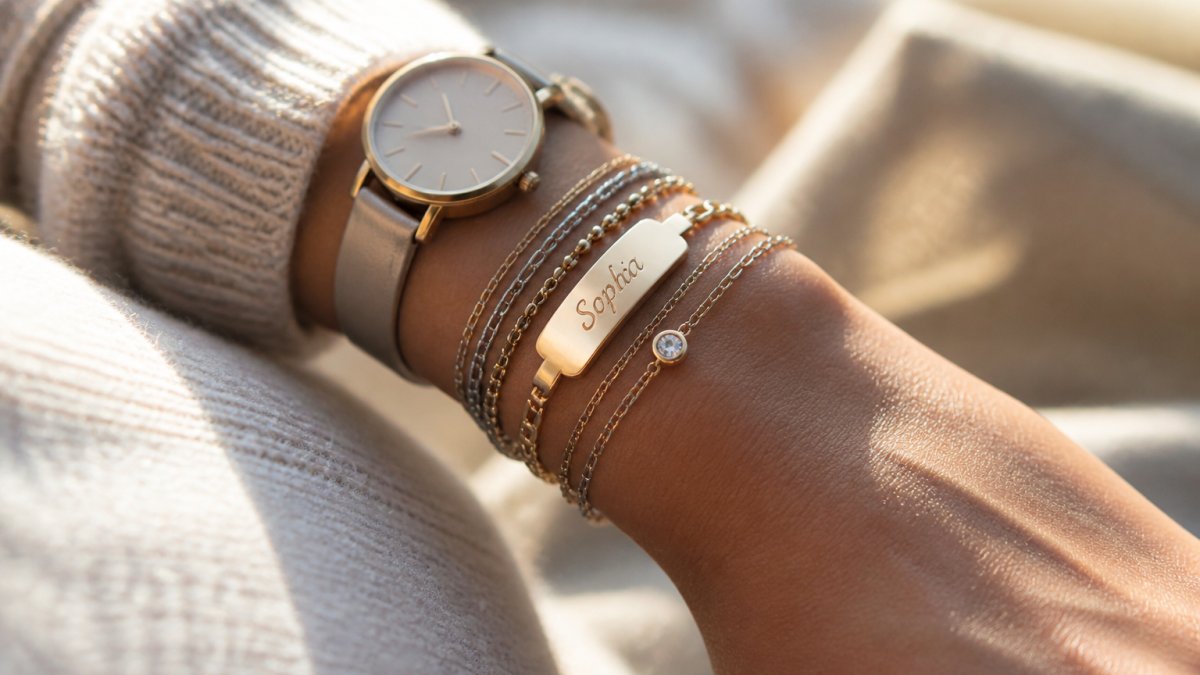
Using Names, Initials, and Engraved Details
A nameplate bracelet with your child's name is deeply personal. Wear it with a simple watch: the watch provides structure, the nameplate tells the story.
Initials work similarly. A bracelet engraved with your spouse's initials or a meaningful date becomes part of your daily identity.
Engraved charms add flexibility: a child's birthstone charm works for everyday wear, an anniversary date charm for special occasions.
Don't overdo it: one or two personalized pieces per wrist is plenty. Let them be the focal point and keep other bracelets simpler.
Personalization by Occasion
The same personalized bracelet can read very differently depending on styling. A few patterns:
- Work and professional settings: Choose one personalized piece and keep the message subtle. A single initial, a small engraved bar, or a short name in a clean font reads as intentional rather than sentimental. Pair it with a slim watch and a plain chain or leather bracelet. Avoid dangling charms, multiple nameplates, or anything that jingles or catches on a keyboard or sleeve.
- Formal events: Let the watch lead. A dress watch with a leather strap and one refined personalized piece, such as a slim engraved bangle or a single charm, keeps the look elegant. Skip beaded or chunky pieces. If the engraving is on the inside of a cuff or the back of a plate, the personalization becomes a private detail rather than a public statement.
- Casual and everyday: This is where you can layer freely. A nameplate, a birthstone charm, and a beaded bracelet can all share a wrist with a sport watch. Mix widths and textures, but keep the total to three or four pieces so each one stays visible.
- Milestone and celebration moments: Anniversaries, graduations, and new babies are when a date or name engraving earns its place as the centerpiece. Wear it alone with a simple watch, or pair it with one complementary piece so the message stays the focus.
Message Visibility and Legibility
A personalized bracelet only works if the message can be read. Font size, engraving depth, and contrast all matter: a shallow engraving on a polished surface disappears in bright light, while a deeper cut or contrasting finish stays legible.
Think about where the message sits when your arm is at rest: a nameplate on top of the wrist is visible to others, one that rotates underneath is mainly for you. An inside engraving keeps it private; an outward-facing plate shares it with the world.
Layering Multiple Bracelets With Purpose
Vary the widths. A thin chain next to a wider metal cuff creates visual interest. A beaded bracelet between two metal pieces balances texture.
Group similar styles: place two delicate bracelets side by side, then add a bolder piece for intentional sections rather than random stacking.
Don't exceed three or four bracelets per wrist. Beyond that, your wrist looks crowded. The individual pieces lose impact.
Protecting Your Watch From Scratches and Wear
Metal-on-metal contact is the biggest threat to a stacked wrist. Stainless steel, gold, and sterling silver sit in a similar hardness range on the Mohs scale, so any can scratch the others. A polished watch case shows every mark; a brushed finish hides more. Knowing which materials touch which determines whether a stack ages well or looks battered in a season.
Spacing and Placement Mechanics
The most effective habit is to leave a gap: slide your bracelets so they rest roughly a quarter inch to half an inch from the watch case when your arm is at rest.
Placement matters as much as spacing. Put your heaviest bracelet on the far side of the stack, away from the watch, so lighter pieces sit between them. Position a nameplate's flat engraved face outward and away from the watch case so its edge isn't grinding against the lugs.
Material Contact: What Scratches What
- Metal against metal: The highest-risk pairing. A steel watch case next to a steel chain bracelet will produce fine hairline scratches over time. A gold bracelet next to a steel watch is worse, because the softer gold takes the damage.
- Metal against leather: Low risk. Leather is soft and acts as a buffer. A leather bracelet between two metal pieces is one of the smartest ways to break up a stack.
- Metal against beads: Moderate risk. Stone, glass, and wood beads are generally softer than metal, but a hard gemstone bead can still mark a polished case. Beads also trap grit, which acts like sandpaper.
- Metal against fabric or cord: Lowest risk. A woven cord or fabric bracelet is the gentlest neighbor for a watch.
Barriers, Rotation, and Upkeep
A thin leather or silicone barrier between the watch and the first bracelet absorbs most friction, and rotating your stack every few days spreads wear across more pieces.
Inspect your bracelets monthly: run a fingertip along the edges and clasps, since a burr you can feel will scratch a watch case. A jeweler can smooth a rough edge quickly.
Finally, match your protection to your watch.
Common Mistakes to Avoid
The most common mistake is ignoring proportion.
Don't mix too many metals without intention.
Don't choose personalized bracelets on price alone. A cheap nameplate tarnishes quickly and looks worn within months.
Skipping the sizing step is another common error.
Styling personalized bracelets with a watch is about balance, intention, and meaning. Your watch marks time.
At Epic Gifts, we believe your jewelry should reflect the people and moments you cherish.
Frequently Asked Questions
Can you wear a bracelet with a watch on the same wrist?
Yes, you can wear personalized bracelets with a watch on the same wrist. The key is spacing them properly to avoid scratching your watch and ensuring the bracelet sits comfortably above or below the watch case. Start with one delicate bracelet and add more if there's room without crowding. Leave at least a quarter-inch of space between the watch and bracelet to allow for movement and reduce friction.
How do you keep bracelets from scratching a watch?
Prevent scratches by maintaining separation between your bracelet and watch. Position bracelets above the watch on your wrist or wear them on the opposite wrist entirely. If stacking on the same wrist, use softer materials like braided leather or fabric straps next to your watch, and place metal or beaded bracelets farther up your arm. Check periodically for signs of wear and rotate your bracelet collection to distribute contact.
What bracelet length works best for stacking with a watch?
For stacking, choose bracelets that fit snugly but allow movement. A personalized bracelet should sit about half an inch above your wrist bone when fastened. Measure your wrist circumference and add one inch for comfort. When wearing multiple bracelets with a watch, ensure each piece has its own space without overlapping. If your watch is slim, you can stack more delicate pieces; if it's chunky, one or two bracelets work better to maintain balance and prevent tangling.
Can you mix metals when wearing a watch and personalized bracelet together?
Absolutely. Mixing metals creates an effortless, polished look. Combine gold, silver, and rose gold for a cohesive appearance by repeating metal tones throughout your stack. For example, pair a gold watch with a gold nameplate bracelet and add a silver chain bracelet for contrast. The key is intentional repetition: use at least two pieces in each metal tone so the mix feels purposeful rather than accidental.


