


 support@epicgifts.org
Table of Contents
- Why Setting Matters for Active Wear
- Best Ring Settings for Active Lifestyles
- Bezel Setting vs. Prong Setting: Durability Comparison
- Most Durable Gemstones for Everyday Wear
- Hardness, Toughness, and Cleavage: What Actually Matters
- Setting and Gemstone Compatibility
- Maintenance and Inspection Schedule
- Frequently Asked Questions
Last Updated: October 17, 2026
Why Setting Matters for Active Wear
The setting you choose makes the difference between a ring that lasts decades and one that fails within months. If you live an active lifestyle, regular workouts, outdoor adventures, or working with your hands, your jewelry faces constant stress.
At Epic Gifts, we understand that meaningful jewelry needs to work as hard as you do, which is why we focus on durable gemstone settings. This guide walks you through the settings and gemstones that actually hold up to daily wear, and how to match them to your lifestyle.
Not all settings protect equally, and not all gemstones are created for active lifestyles. A stunning emerald in a delicate setting might work for special occasions, but it will chip or crack under regular wear.
Best Ring Settings for Active Lifestyles
The setting is your stone's armor, determining how much protection the gemstone receives and how secure it stays. For active lifestyles, certain settings outperform others dramatically.
Bezel Settings: Maximum Protection
A bezel setting wraps a metal rim completely around the edge of your gemstone, holding it in place from all sides. This design is the gold standard for active wear.
Here's why bezel settings win for durability:
- The metal rim shields the stone's edge from impacts and bumps
- No exposed facets means less risk of chipping or cracking
- The stone sits lower in the ring, reducing snagging on clothing or objects
- The setting itself is less likely to bend or shift under pressure
Bezel settings work especially well for softer gemstones like emerald, aquamarine, or morganite, since the protective metal compensates for their natural vulnerability. They also suit harder stones like sapphire or ruby when you want maximum security.
The trade-off: bezel settings show less of the stone's brilliance because the metal covers part of the edge. If maximum sparkle matters more than protection, you might prefer a different approach, but for active lifestyles, that trade-off is worth it.
Channel Settings: Secure and Sleek
A channel setting places stones side by side in a groove, with metal walls on either side holding them in place. You'll often see it in wedding bands with multiple small diamonds or gemstones.
Channel settings offer solid protection because:
- Multiple stones distribute stress across the ring
- The metal channel on both sides prevents lateral movement
- The design is inherently low-profile, reducing snagging
- There are no protruding prongs to bend or catch
Channel settings work best with multiple stones, or smaller center stones flanked by accents. They excel for people who want a secure, modern look without the bulkiness of a bezel.
The limitation: channel settings aren't ideal if you want a single large center stone as your focal point. The metal channel takes up space, and the design works better with multiple smaller stones. For a single large gemstone, bezel or low-profile settings are more practical.
Low-Profile and Flush Settings
Low-profile settings sit closer to your finger, while flush settings place the stone nearly level with the band. Both minimize the distance between your hand and the stone, reducing the force impacts can apply.
These settings excel for active lifestyles because:
- Less height means less catching on gloves, equipment, or clothing
- Impacts hit the metal band, not the stone's edge
- The ring feels more comfortable during physical activity
- They're less likely to snag during workouts or outdoor activities
Low-profile and flush settings work with almost any gemstone but shine with durable stones like sapphire or ruby. Pair a hard gemstone with a low-profile setting and you have a combination that handles serious activity.
The consideration: low-profile settings require careful sizing. Too loose and the stone can shift; too tight and it may cut off circulation. Work with a jeweler who understands your lifestyle to get the fit right.
Bezel Setting vs. Prong Setting: Durability Comparison
A prong setting uses metal claws (typically four or six) to grip the stone from above. It's traditional and shows off a stone's full beauty, but for active lifestyles it has real limitations.
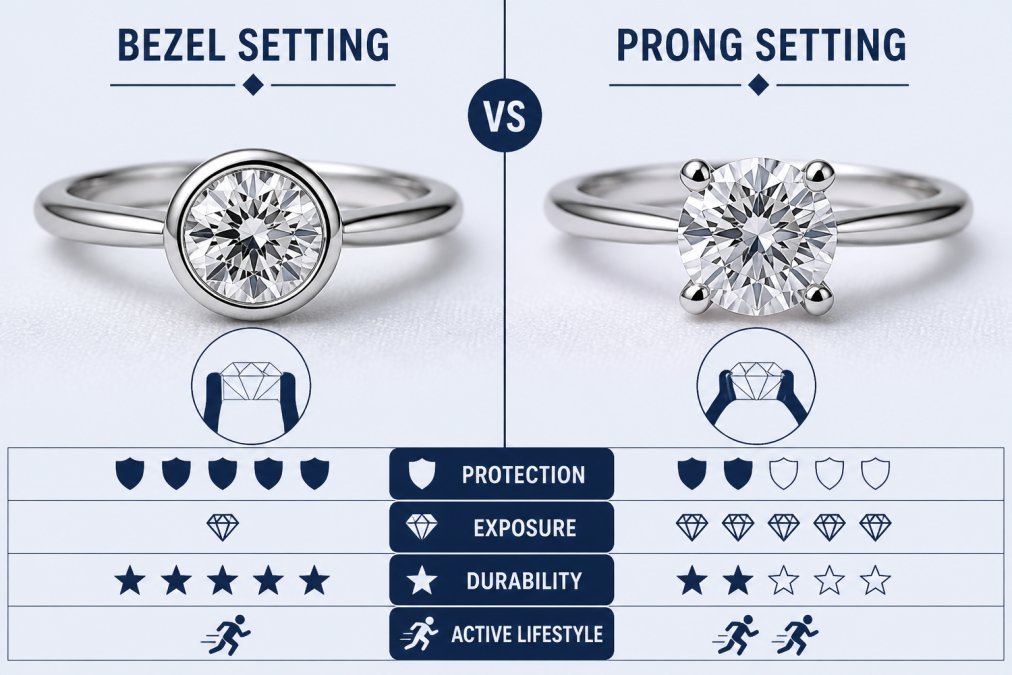
| Aspect | Bezel Setting | Prong Setting |
|---|---|---|
| Stone Protection | Metal rim shields all edges | Only top is held; edges exposed |
| Impact Resistance | Excellent; metal absorbs force | Poor; force transfers to stone |
| Edge Chipping Risk | Very low | High, especially for softer stones |
| Snagging Potential | Minimal; sits low | Moderate to high; prongs can catch |
| Maintenance | Occasional polish; very stable | Regular inspection; prongs can loosen |
| Best For | Active lifestyles, daily wear | Special occasions, careful handling |
Prong settings show more of the stone, but those exposed edges are exactly where damage happens.
Prongs can also loosen over time, especially during physical activity. A loose prong means the stone can shift or fall out, so regular inspection becomes necessary, something active people often forget.
If you love the look of a prong setting but need durability, consider a six-prong design instead of four. More prongs distribute stress more evenly and provide better security.
Most Durable Gemstones for Everyday Wear
Gemstone hardness matters, but it's not the whole story. Understanding how hardness differs from toughness helps you choose a stone that will survive your lifestyle.
Sapphire and Ruby: The Hardest Choices
Sapphire and ruby are both forms of corundum, ranking 9 on the Mohs hardness scale, only diamond ranks higher at 10. They resist scratching better than almost any other gemstone.
For active lifestyles, sapphire and ruby are the top choices because:
- They resist scratching from daily contact with skin, clothing, and surfaces
- They can handle impacts without chipping (in most cases)
- They maintain their polish and brilliance over decades of wear
- They work in any setting, from delicate prongs to protective bezels
Sapphires come in every color, blue, pink, yellow, green, orange, though blue is most common. Rubies are red corundum. Both are ideal if you want a gemstone that will genuinely last through an active lifestyle without special care.
The reality: even a 9 on the Mohs scale can chip if hit hard enough. Hardness measures resistance to scratching, not resistance to breaking. A sapphire won't scratch easily, but it can still fracture under the right impact.
Emerald and Aquamarine: Beauty With Care
Emerald and aquamarine both rank 7.5 to 8 on the Mohs hardness scale. Both are softer than sapphire, so they scratch more easily, but softness doesn't mean fragile, it means they need the right setting and care.
Emeralds and aquamarines are beautiful choices for active lifestyles if you:
- Pair them with protective settings like bezel or channel designs
- Understand their limitations and accept the need for occasional maintenance
- Avoid extreme impacts or rough handling
- Inspect your ring regularly for signs of damage
Emeralds are particularly vulnerable because many contain natural inclusions and fractures, making them prone to chipping if struck. Aquamarines are more durable than emeralds but still softer than sapphire.
The trade-off: emeralds and aquamarines offer colors and transparency that sapphires sometimes can't match. If you love the specific beauty of an emerald or aquamarine, a bezel setting and careful handling can make it work for active wear.
Hardness, Toughness, and Cleavage: What Actually Matters
Hardness is not the same as durability.
Hardness measures how well a stone resists scratching, on the Mohs scale from 1 (softest) to 10 (hardest). It tells you whether your stone will scratch from daily contact.
Toughness measures how well a stone resists breaking or chipping under impact. A stone can be hard but not tough. Diamond, for example, ranks 10 on hardness but only 5.5 on toughness.
Cleavage is a gemstone's tendency to break along natural planes within its structure. If a stone with pronounced cleavage is struck along one of those planes, it can fracture cleanly.
For active lifestyles, toughness and cleavage matter as much as hardness:
- A hard stone with poor toughness can still chip under impact
- A stone with pronounced cleavage can fracture from a single wrong hit
- Sapphire and ruby have excellent hardness, good toughness, and no pronounced cleavage, the ideal combination
- Emerald has moderate hardness, poor toughness, and significant cleavage, it needs protection
Understanding these three factors helps you choose a gemstone and setting combination that actually works for your lifestyle, not just one that sounds good in theory.
Setting and Gemstone Compatibility
The best durable gemstone setting depends on which gemstone you choose. They work together as a system.
Hard, tough gemstones like sapphire and ruby can work in almost any setting. A bezel setting provides maximum protection, but even a prong setting will keep a sapphire safe if the setting is well-made and properly maintained.
Softer, more fragile gemstones like emerald or aquamarine demand protective settings. A bezel setting or channel setting shields the stone's vulnerable edges.
The metal matters too. Platinum is extremely durable and resists bending. Gold (especially 14K or 18K) is softer and can bend under pressure, loosening stones.
Think of the gemstone and setting as partners in creating durable gemstone settings.
Maintenance and Inspection Schedule
Even the most durable gemstone setting needs care. Regular maintenance prevents small problems from becoming big ones.
Monthly: Inspect your ring visually. Look for any loose prongs, bent metal, or visible damage to the stone.
Annually: Have a professional jeweler inspect your ring. They can spot damage you might miss and tighten any loose settings.
After any impact: If your ring hits something hard, have it inspected immediately.
The maintenance burden depends on your gemstone and setting. A sapphire in a bezel might need annual inspection; an emerald in a prong setting might need monthly checks. Choose the combination that fits your willingness to maintain it.
Choosing jewelry for an active lifestyle means thinking beyond beauty. The right durable gemstone setting keeps your meaningful gift safe through years of real life.
Frequently Asked Questions
Which gemstone is the most durable for everyday wear?
Sapphire and ruby rank among the hardest gemstones, scoring 9 on the Mohs hardness scale, second only to diamond. Both resist scratching and chipping well during active lifestyles. However, hardness alone doesn't guarantee durability; toughness and cleavage patterns matter too. Sapphire's crystal structure makes it resistant to fracture, making it ideal for rings worn daily. Emerald and aquamarine, while beautiful, are more fragile and prone to internal fractures, so they require more careful handling and protective settings.
Are bezel settings better for active lifestyles than prong settings?
Bezel settings offer superior protection for active wear because they wrap a metal rim around the stone's edge, shielding it from impact and snagging. Prong settings expose more of the stone's surface, making it vulnerable to scratches and chips during exercise or manual work. For someone with an active lifestyle, a bezel setting reduces the risk of stone loss and damage significantly. However, bezel settings do show more of the metal and slightly reduce the stone's sparkle compared to prong settings, so personal preference plays a role in the choice.
What's the difference between hardness and toughness in gemstones?
Hardness measures a stone's resistance to scratching, rated on the Mohs hardness scale. Toughness refers to how well a stone resists fracturing or chipping when struck. A gemstone can be hard but not tough, for example, a diamond is extremely hard but can shatter if hit at the right angle due to its cleavage planes. Emerald has moderate hardness but poor toughness because of internal fractures. For active lifestyles, you need both hardness and toughness; sapphire and ruby excel in both categories, making them the safest choices for daily wear.
How often should I have my durable gemstone setting checked?
Have your ring inspected every 6-12 months, or immediately if you notice any looseness, scratching, or damage. Regular inspection catches small problems before they become costly repairs. Even durable settings experience metal wear and prong loosening over time, especially in active lifestyles. Professional jewelers can tighten settings, check for hidden fractures, and clean the stone properly. If you wear your ring during sports, exercise, or manual work, schedule inspections more frequently, every 6 months is ideal to ensure the stone remains secure.


