


 support@epicgifts.org
Table of Contents
- Why Proper Storage Matters for Anniversary Jewelry
- Prepare Your Jewelry: How to Clean Jewelry Before Storing
- Choose the Right Storage Container for Your Pieces
- How to Prevent Jewelry from Tarnishing
- How to Store Necklaces Without Tangling
- How to Store Jewelry While Traveling
- Storage by Material: Gold, Platinum, and Gemstones
- Common Storage Mistakes and How to Avoid Them
- Frequently Asked Questions
Last Updated: October 12, 2026
Why Proper Storage Matters for Anniversary Jewelry
Store anniversary jewelry with care because it holds meaning beyond its material value. How you store anniversary jewelry properly determines whether it stays radiant for decades or deteriorates within months.
Air, humidity, and temperature swings speed tarnishing; tangled necklaces bend or snap; gemstones and metals scratch when pieces touch. The right storage prevents all of this.
Proper storage protects your investment so the jewelry looks as stunning on your 50th anniversary as on your first.
Prepare Your Jewelry: How to Clean Jewelry Before Storing
Clean your pieces before putting them away; skin oils, dust, and residue cause tarnishing and dullness.
For most jewelry, use this simple method:
- Fill a soft bowl with lukewarm water
- Add a drop of mild dish soap
- Soak your jewelry for 2-3 minutes
- Gently brush with a soft-bristled toothbrush
- Rinse thoroughly under clean running water
- Pat dry with a soft, lint-free cloth
- Let air dry completely before storing
Never use harsh chemicals or abrasive cloths. These damage delicate finishes and gemstones.
This suits gold and platinum. For gemstones, avoid soaking porous stones: diamonds and rubies are fine, but opals and pearls need extra care.
Choose the Right Storage Container for Your Pieces
Your storage container is the foundation of proper jewelry care. The right choice depends on how much you own, how often you wear it, and how long you'll store it.
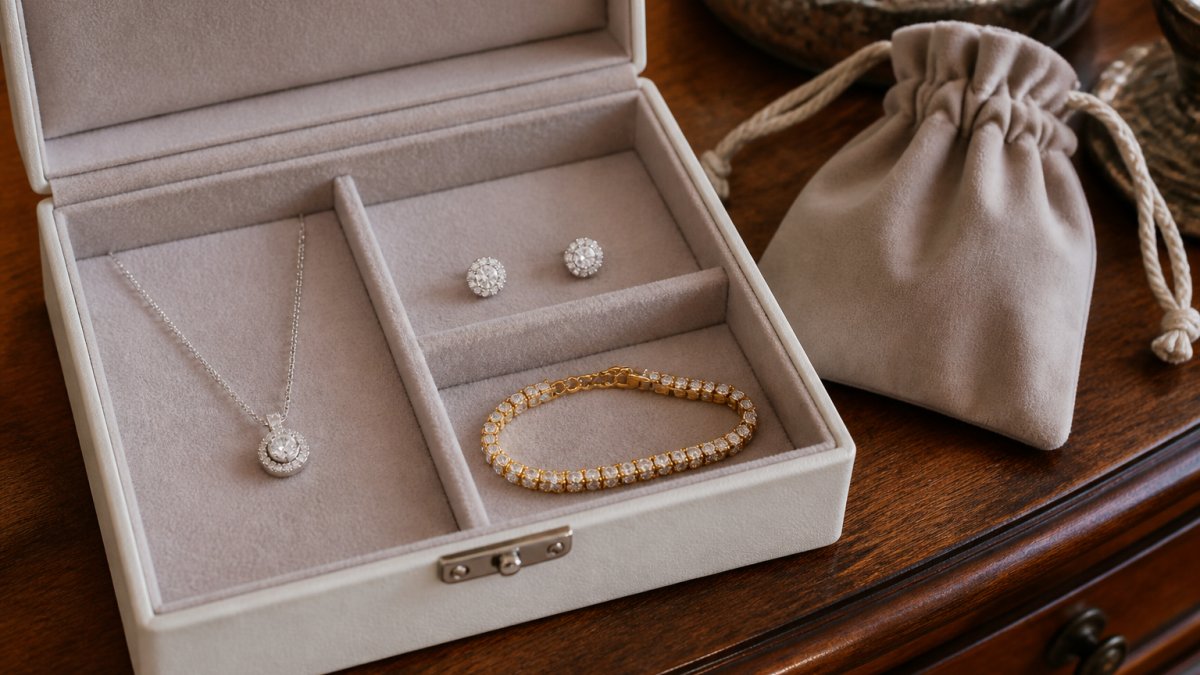
Jewelry Boxes with Compartments
A quality jewelry box with individual compartments prevents pieces from touching. Line each with soft velvet or felt to protect against scratches.
Look for boxes with:
- Separate slots for necklaces and bracelets
- Earring holders to keep pairs together
- A clasp closure to keep the lid secure
- Lining that won't snag or fade
- A size that fits your collection without crowding
Compartmented boxes work best for jewelry you wear regularly, though they take up dresser or shelf space.
Soft Pouches and Zip-Close Bags
Individual soft pouches give each delicate piece its own barrier against dust and air.
Pouches work especially well for:
- Fine chains that tangle easily
- Gemstone rings that need scratch protection
- Pieces you travel with
- Jewelry stored long-term
Use unbleached muslin or microfiber pouches. Avoid plastic bags, which trap moisture and cause tarnishing; fabric zip-close bags are fine.
For anniversary necklaces and bracelets, individual pouches prevent the metal from contacting other pieces, a key step in how to store necklaces without tangling.
Original Gift Boxes
If your anniversary jewelry came in an original gift box, keep it: these boxes have custom padding that fits the piece perfectly.
Original boxes offer perfect-fit protection and professional presentation. Store the box in a larger container or closet to protect it from dust, ideal if you have just a few special pieces.
How to Prevent Jewelry from Tarnishing
Tarnishing happens when metals react with oxygen and sulfur in the air. Preventing it means controlling what your jewelry is exposed to.
Keep jewelry in a cool, dry place. Humidity accelerates tarnishing, so avoid bathrooms, kitchens, or basements where moisture fluctuates. Choose a bedroom closet or dresser drawer with stable temperature and low humidity.
Limit air exposure. Store jewelry in closed containers rather than on open shelves. Sealed pouches and boxes reduce contact with oxygen and dust.
Use silica gel packets. Place one in your storage container to absorb excess moisture, and replace it every 3-6 months.
Separate different metals. Gold and silver can react when stored together. Keep them in separate compartments or pouches.
Store tissue paper between layers. If you stack pieces, place unbleached tissue paper between them to prevent contact and reduce scratching.
Gold anniversary jewelry tarnishes less than silver, but the same principles apply: keep pieces cool and dry.
How to Store Necklaces Without Tangling
Fine chains tangle easily, especially delicate anniversary necklaces, and untangling them risks damage to the chain or clasp.
Store each necklace separately. This is the most important rule. Never coil multiple necklaces together.
Use individual soft pouches. Place each necklace in its own unbleached muslin or microfiber pouch; fabric-lined zip-close bags work, plastic does not.
For longer necklaces, try this method:
- Lay the necklace flat on a soft surface
- Coil it gently in a loose spiral (not tight)
- Place it in a small pouch
- Close the pouch carefully
Hang necklaces on a dedicated stand. For anniversary necklaces you wear regularly, choose a stand with soft padding on the hooks.
Clasp necklaces before storing. Fasten the clasp to keep the chain from moving around inside the pouch. This simple step prevents the chain from bunching or knotting.
When learning how to store jewelry while traveling, necklaces deserve special attention. Wrap each one individually in tissue paper before placing in a soft pouch. This prevents tangling during transport.
How to Store Jewelry While Traveling
Travel storage differs from at-home storage because jewelry experiences movement and temperature changes.
Pack jewelry last and unpack first. This minimizes time in luggage where pieces can shift and collide.
Use a dedicated jewelry travel case. These compact organizers have compartments and soft padding, and fit in carry-on luggage.
Wrap each piece individually. Use unbleached tissue paper to wrap necklaces, bracelets, and rings separately. This prevents tangling and scratching.
Keep jewelry in your carry-on. Never pack valuable anniversary jewelry in checked luggage. Carry-on keeps your pieces safe and under your control.
Avoid hotel safes for delicate pieces. They're secure but don't protect against humidity or temperature changes. Keep pieces in your carry-on or your room's closet.
Store in a cool, dry spot in your hotel room. Use the same principles as home storage. Keep pieces away from bathrooms and direct sunlight.
For shorter trips, a soft pouch in your carry-on works fine; for longer journeys, invest in a travel jewelry case.
Storage by Material: Gold, Platinum, and Gemstones
Anniversary jewelry often combines materials with different storage tolerances, and treating everything the same dulls finishes, clouds stones, and loosens settings. Store each piece according to its most delicate component.
Gold (yellow, white, and rose). Gold resists tarnish, but its alloys behave differently. White gold is usually rhodium-plated, and that plating wears thin with friction, so store it in its own soft pouch.
Platinum. Platinum is dense, hypoallergenic, and naturally tarnish-resistant, so it needs less environmental protection than silver. The main risk is mechanical: it's heavy and can dent or scratch softer metals beside it.
Sterling silver. Silver tarnishes faster than any other common jewelry metal because it reacts with sulfur in the air. Store it in an anti-tarnish pouch, a tarnish-resistant cloth, or a sealed container with a silica gel packet.
Diamonds. Diamonds are the hardest gemstone, but hardness is not toughness: a diamond can chip another diamond and will scratch gold, platinum, and every colored stone. Store each diamond piece in its own pouch or compartment, and clean it before storage since diamonds attract grease.
Rubies and sapphires. Both are corundum, just below diamond on the hardness scale. They can share a compartmented box, but keep them away from softer stones like emeralds, opals, and pearls. Warm soapy water is safe for both.
Emeralds. Emeralds are beryl and typically contain internal inclusions that make them more fragile than their hardness suggests. Never clean them in an ultrasonic cleaner or with steam.
Opals. Opals contain water within their structure and are sensitive to humidity swings and rapid temperature changes. Store them in a cool, stable spot with moderate humidity, not in a sealed container with a heavy silica pack that could dry them out.
Pearls. Pearls are organic and among the most delicate jewelry materials: soft, porous, and easily damaged by perfume, hairspray, and skin oils. Wipe them with a soft damp cloth after wearing, dry completely, and store in a soft pouch or silk-lined compartment.
Mixed-material pieces. When an anniversary piece combines two or more of the above, store it according to the most delicate material. A gold ring set with an opal, for example, follows opal rules: cool, stable, moderate humidity, and no silica pack against the stone.
Common Storage Mistakes and How to Avoid Them
Most storage damage comes from a handful of repeatable mistakes. The fix is rarely complicated, but understanding why each one causes harm helps you spot the problem before it becomes permanent.
Storing jewelry in the bathroom. Steam from showers and sinks raises humidity fast, the leading driver of silver tarnish and pearl damage. Move storage to a bedroom closet or dresser drawer where humidity stays stable.
Leaving jewelry on a windowsill or in direct sun. UV light fades gemstones like amethyst, citrine, and rose quartz, and can degrade the finish on treated stones.
Using plastic zip-close bags for silver or pearls. Plastic traps moisture and sulfur against the metal, accelerating tarnish, and pearls can dry out or yellow in an airtight bag.
Storing jewelry while it is still damp. Moisture trapped in a clasp, behind a stone, or inside a hollow chain link causes tarnish and can loosen a setting.
Stacking pieces without separation. Two rings in one compartment scratch each other, and a diamond will scratch gold or platinum. Use individual pouches or compartments; if you must stack, place unbleached tissue paper between layers.
Ignoring silica gel packets. Silica gel absorbs ambient moisture but saturates over time.
Storing jewelry in its original gift box indefinitely. Original boxes are designed for presentation, not long-term storage; many use paper or foam that traps moisture or releases acids over years.
Storing jewelry with rubber bands or latex. Rubber and latex release sulfur, the primary cause of silver tarnish. Never use a rubber band to hold a chain or ring inside a box.
Forgetting to inspect pieces you rarely wear. Anniversary jewelry often sits unworn for months.
Storing jewelry in a safe deposit box without a plan. Safe deposit boxes are secure but dry, with no humidity control, so pearls and opals can dry out over years.
Mistake: Keeping jewelry in a hot car or attic. Extreme heat warps settings, damages adhesives, and fades gemstones. Store jewelry in a climate-controlled part of the home.
Mistake: Using the same storage spot for every piece forever. Rotating storage locations prevents wear patterns on the lining and lets you inspect pieces you might otherwise forget.
Frequently Asked Questions
What is the best way to store anniversary jewelry at home?
Store anniversary jewelry in a dedicated jewelry box with soft compartments or individual pouches in a cool, dry place away from direct sunlight. Keep pieces separate to prevent scratching and tangling. Use silica gel packets to control humidity, and avoid storing jewelry in bathrooms where moisture is high. Check your collection every few months to ensure pieces remain in good condition.
How do you prevent fine jewelry from tarnishing during storage?
Clean jewelry thoroughly before storing to remove oils and residue that accelerate tarnishing. Store pieces in airtight containers or zip-close bags to limit air exposure. Keep jewelry away from humidity, extreme temperature fluctuations, and direct sunlight. For gold and platinum pieces, individual soft pouches work best. Silica gel packets inside storage containers help maintain a dry environment and slow oxidation.
Should different types of jewelry be stored separately?
Yes, storing different types separately prevents damage. Hard metals like platinum and diamonds can scratch softer metals and gemstones. Use individual compartments or pouches for necklaces, bracelets, earrings, and rings. This approach also prevents tangling of fine chains and keeps delicate pieces undisturbed. Heavier pieces should have their own space to avoid pressure on lighter items.
How often should you check stored jewelry?
Check stored anniversary jewelry every 3-6 months to monitor for tarnishing, moisture buildup, or other environmental damage. Inspect clasp mechanisms and settings for any loosening. If you notice moisture or discoloration inside storage containers, replace silica gel packets immediately. Regular inspections help catch problems early and ensure your sentimental pieces remain in excellent condition for years to come.


