


 support@epicgifts.org
Table of Contents
- Natural vs Lab-Grown Birthstones: Key Differences at a Glance
- How Natural Birthstones Form in the Earth
- How Lab-Grown Birthstones Are Created
- Are Lab-Grown Gemstones Real?
- How to Tell Natural and Lab-Grown Gemstones Apart
- Lab-Grown Gemstone Price and Value Comparison
- Which Birthstones Are Actually Available Lab-Grown
- Durability and Everyday Wear: Natural vs Lab-Grown
- Frequently Asked Questions
Last Updated: October 19, 2026
Natural vs Lab-Grown Birthstones: Key Differences at a Glance
When choosing a birthstone gift, you're faced with a fundamental decision about natural vs lab-grown birthstones. Both are real gemstones with identical chemical compositions, yet they differ in origin, price, and the story they tell. We help customers navigate this choice by understanding what actually matters for your specific situation.
The distinction between natural and lab-grown birthstones isn't about quality or authenticity. Lab-grown gemstones are chemically identical to their natural counterparts, formed through controlled processes rather than geological time. What changes is availability, cost, and personal preference. Some buyers prioritize the rarity and geological history of natural stones. Others value the affordability and environmental considerations of lab-grown options.
This guide breaks down the real differences so you can make an informed decision aligned with your values and budget.
Comparison Table
| Aspect | Natural Birthstones | Lab-Grown Birthstones |
|---|---|---|
| Chemical Composition | Identical to lab-grown | Identical to natural |
| Formation Time | Millions of years | Weeks to months |
| Price Point | Higher | Lower (30-40% typically) |
| Availability | Limited for rare stones | Widely available |
| Rarity & Uniqueness | Each stone is one-of-a-kind | Consistent quality |
| Environmental Impact | Mining concerns | Minimal impact |
| Durability | Identical hardness | Identical hardness |
| Certification | Grading reports available | Grading reports available |
How Natural Birthstones Form in the Earth
Natural gemstones develop through geological processes over millions of years. Heat, pressure, and time transform raw minerals into the crystals we recognize as birthstones. Each natural gemstone carries the unique characteristics of its formation environment, including natural inclusions and color variations that make it distinct.
The April birthstone, diamond, forms deep in the Earth's mantle under extreme pressure. Rubies and sapphires, the July and September birthstones, crystallize in metamorphic rock. Emeralds, May's birthstone, grow in hydrothermal veins. Each formation process creates subtle variations in color, clarity, and internal structure that gemologists use to authenticate and grade the stones.
Natural gemstones often contain inclusions, tiny minerals or fractures trapped during formation. These aren't flaws; they're proof of the stone's geological journey. Many buyers value this authenticity. The rarity of certain natural birthstones, particularly high-quality rubies and emeralds, makes them more expensive and harder to source consistently.
How Lab-Grown Birthstones Are Created
Lab-grown birthstones are created in controlled environments using two primary methods: the High Pressure High Temperature (HPHT) process and Chemical Vapor Deposition (CVD). Both methods replicate the conditions that form natural gemstones, but compress the timeline from millions of years to weeks or months.
In the HPHT method, scientists place raw carbon or mineral seeds in a chamber where extreme pressure and heat simulate Earth's mantle conditions. The material crystallizes around the seed, building layer by layer into a finished gemstone.
The result is a gemstone with identical crystal structure and chemical properties to its natural counterpart. Lab-grown diamonds, rubies, sapphires, and emeralds are all widely available. The controlled environment means fewer inclusions and more consistent color, which appeals to buyers seeking uniform quality. Laboratories can also create gemstones in colors rarely found in nature.
Are Lab-Grown Gemstones Real?
Yes. Lab-grown gemstones are absolutely real gemstones. They possess the same chemical composition, crystal structure, and physical properties as natural birthstones. The only difference is origin: one formed in the Earth over geological time, the other in a laboratory over weeks.
This is a critical distinction from simulants or imitations. A cubic zirconia, for example, is not a real diamond, it has a different chemical makeup and will cloud over time. Lab-grown diamonds are real diamonds. Lab-grown rubies are real rubies. They will pass gemological testing and are graded using the same standards as natural stones.
The Gemological Institute of America (GIA) grades lab-grown gemstones using the same Four Cs framework used for natural stones: carat weight, color, clarity, and cut. Many lab-grown birthstones come with certification reports that disclose their origin. This transparency is standard in the industry.
How to Tell Natural and Lab-Grown Gemstones Apart
Distinguishing natural from lab-grown birthstones requires specialized equipment and expertise. To the naked eye, they are visually identical. Even under magnification, the differences are subtle and require trained observation.
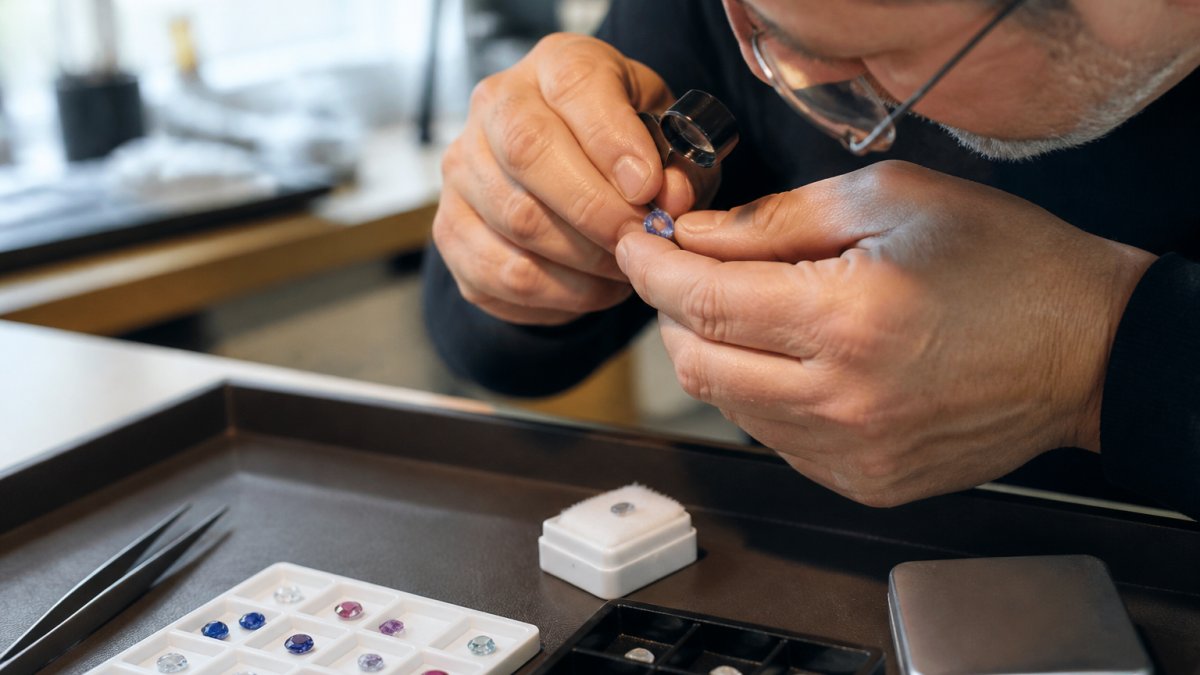
Gemologists look for specific characteristics. Natural gemstones often contain inclusions, tiny minerals or fractures that formed during their geological journey. Lab-grown stones typically have fewer inclusions and more uniform color.
The most reliable method is certification. Reputable gemological laboratories issue grading reports that disclose whether a birthstone is natural or lab-grown.
Many buyers don't need to distinguish between them. If you're purchasing a birthstone gift and origin doesn't affect your decision, the visual and physical identity means the distinction is purely academic.
Lab-Grown Gemstone Price and Value Comparison
Lab-grown birthstones typically cost less than comparable natural stones of similar quality. This price difference reflects the lower production cost and reduced scarcity.
The affordability of lab-grown birthstones matters when selecting high-quality stones. A larger lab-grown sapphire or emerald becomes accessible at the same budget as a smaller natural stone. For buyers prioritizing size or quality grade over origin, lab-grown options stretch purchasing power considerably.
However, natural birthstones often hold resale value better than lab-grown alternatives. If you view the purchase as an investment or heirloom piece, natural gemstones may appreciate or maintain value more reliably over decades.
For gifts and everyday wear, the price advantage of lab-grown birthstones is straightforward: you pay less for a chemically identical stone. The value proposition depends on whether resale value or initial affordability matters more to your situation.
Which Birthstones Are Actually Available Lab-Grown
Availability is the single most practical constraint in this decision, and it varies dramatically by birthstone. The honest answer is that lab-grown production clusters around a handful of stones where the economics and chemistry work, while other birthstones are rare, unavailable in a given color, or only offered as simulants rather than true lab-grown gems.
Here is the month-by-month reality, based on common industry availability:
- January (garnet): True lab-grown garnet is uncommon. Most "lab" garnet on the market is actually a simulant such as cubic zirconia or glass in a garnet color. If origin matters, natural is usually the realistic choice.
- February (amethyst): Lab-grown quartz in amethyst color exists but is limited; much of what is sold as synthetic amethyst is treated or imitation material. Natural amethyst is abundant and affordable, so lab-grown offers little advantage.
- March (aquamarine): Lab-grown aquamarine is rare. Buyers usually choose natural aquamarine or a blue simulant.
- April (diamond): The most mature lab-grown market by far, with broad availability across carat, color, and clarity grades and full grading reports.
- May (emerald): Lab-grown emerald is available but in smaller quantities than diamond or sapphire; stones often show fewer inclusions than natural emeralds.
- June (pearl, alexandrite, moonstone): Cultured pearls are effectively the "lab-grown" pearl and are widely available. Lab-grown alexandrite exists in limited quantities and can be color-change; lab-grown moonstone is uncommon.
- July (ruby): Widely available lab-grown, with strong color consistency and competitive pricing.
- August (peridot, spinel): Lab-grown peridot is uncommon; lab-grown spinel is limited. Natural is the typical route.
- September (sapphire): Widely available lab-grown in blue and in fancy colors that are rare in nature.
- October (opal, tourmaline): Lab-grown opal is essentially unavailable as a true synthetic; most "lab opal" is a simulant. Lab-grown tourmaline is rare.
- November (topaz, citrine): Lab-grown topaz and citrine are limited; treated natural material is more common.
- December (turquoise, tanzanite, zircon): Lab-grown turquoise is typically a simulant or reconstituted material, not a true lab-grown gem. Lab-grown tanzanite is rare, and lab-grown zircon is uncommon.
Two patterns explain most of this. First, lab-grown production is economically viable mainly for high-value stones where the price gap justifies the cost, diamond, ruby, sapphire, and to a lesser degree emerald.
That distinction matters. A blue cubic zirconia is not a lab-grown sapphire, and a lab-created opal simulant is not a lab-grown opal. If a seller describes a stone as "lab-grown," ask whether it is a true lab-grown gemstone with the same chemical composition as the natural stone, or a simulant made of different material.
Durability and Everyday Wear: Natural vs Lab-Grown
Origin does not change durability. A lab-grown diamond is as hard as a natural diamond, and a lab-grown ruby is as scratch-resistant as a natural ruby, because the crystal structure is the same. What does change durability is the birthstone itself, and that is where most buying mistakes happen.
Hardness (resistance to scratching) and toughness (resistance to chipping and breaking) are different properties, and a stone can be hard but brittle. The Mohs scale is the common reference:
- Diamond (April): Mohs 10, excellent for daily wear, though it can chip along cleavage planes with a sharp impact.
- Ruby and sapphire (July, September): Mohs 9, excellent for rings and everyday pieces; corundum is both hard and tough.
- Emerald (May): Mohs 7.5-8, but typically brittle with surface-reaching inclusions; best for earrings, pendants, or occasional-wear rings rather than daily-wear rings.
- Quartz family, amethyst, citrine, rose quartz (February, November): Mohs 7, good for everyday wear with reasonable care; avoid harsh chemicals and extreme heat.
- Garnet (January): Mohs 6.5-7.5 depending on variety, generally suitable for daily wear.
- Peridot (August): Mohs 6.5-7, softer and more prone to scratching; better for pendants and earrings than daily-wear rings.
- Opal (October): Mohs 5.5-6.5, brittle and sensitive to heat and chemicals; best for occasional wear and protective settings.
- Turquoise (December): Mohs 5-6, porous and sensitive to chemicals and cosmetics; needs care and is often treated or stabilized.
- Pearl (June): Mohs 2.5-4.5, soft and sensitive to acids, perfume, and cosmetics; best for earrings and necklaces worn after cosmetics are applied.
Lab-grown versions follow the same profile as their natural counterparts. A lab-grown emerald is still relatively brittle, and a lab-grown opal, where available as a true lab-grown gem, would still be soft.
Practical care guidance follows from those numbers. For daily-wear rings, diamond, ruby, and sapphire are the safest choices in either origin. For softer stones such as opal, pearl, and turquoise, choose earrings or pendants, set them in protective bezels, and put them on last and take them off first.
Frequently Asked Questions
Are lab-grown birthstones real gemstones?
Yes, lab-grown birthstones are chemically and physically identical to natural gemstones. They contain the same crystal structure and composition as stones formed in the earth. The only difference is their origin: lab-grown stones are created in a controlled environment rather than mined. Gemological laboratories recognize them as genuine gemstones, and they perform identically in jewelry. The term 'real' refers to their authentic chemical makeup, not their origin.
What's the main price difference between natural and lab-grown birthstones?
Lab-grown birthstones typically cost less than comparable natural stones of similar quality and size. The price advantage comes from faster production timelines and lower mining costs. For example, lab-grown diamonds and sapphires offer significant savings without sacrificing durability or appearance. However, pricing depends on the specific gemstone, quality grade, and retailer.
How can I tell if a birthstone is natural or lab-grown?
Visual inspection alone is nearly impossible, natural and lab-grown birthstones look identical to the naked eye. Gemological testing requires specialized equipment like spectroscopy or microscopy to detect subtle differences in growth patterns and inclusions. Reputable jewelers provide gemological reports that identify the stone's origin. Always ask for certification from a recognized lab (like the Gemological Institute of America) before purchasing. Disclosure is legally required in most cases, so verify the seller states the origin clearly.
Which birthstones actually come in lab-grown versions?
Diamonds (April), rubies (July), and sapphires (September) have mature lab-grown markets with excellent availability and pricing. Emeralds (May) and other birthstones are increasingly available lab-grown, though options vary by retailer. Some birthstones like opal (October) and pearl (June) have limited lab-grown production. When shopping for a specific birth month, confirm lab-grown availability with your jeweler.


