


 support@epicgifts.org
Table of Contents
- Why Dirt Gets Trapped in Deep Jewelry Engravings
- Tell Dirt Apart From Intentional Darkening and Tarnish
- How to Clean Engraved Jewelry: A Step-by-Step Method
- Cleaning Jewelry With a Soft Toothbrush
- Choosing a Jewelry Cleaning Solution for Gold and Silver
- Cleaning Jewelry With an Ultrasonic Cleaner
- Tools for Narrow Grooves and What to Avoid
- When to Hand It to a Professional Jeweler
- Frequently Asked Questions
Last Updated: October 18, 2026
Why Dirt Gets Trapped in Deep Jewelry Engravings
Dirt collects in deep jewelry engravings because engraved grooves are tiny reservoirs where skin oils, soap film, lotion, dust, and lint settle into recessed lettering, out of reach of a cloth.
Deep engraving is cut or lasered into the metal, so the walls are microscopically rough and grip debris like a fine file.
Common culprits:
- Hand lotion and sunscreen that dry inside the grooves
- Soap scum from daily handwashing
- Dust and lint from sitting in a jewelry box
Dirt on top of the metal lifts easily, but harsh cleaning can scratch the finish around it, a trade-off that shapes every step below.
Tell Dirt Apart From Intentional Darkening and Tarnish
Before you clean, confirm the dark material is actually dirt. Many engraved pieces are deliberately darkened inside the lettering so the design reads clearly; that fill is part of the finish, and scrubbing it away ruins the look.
Here's how to check:
- Look at the pattern. Intentional darkening sits evenly inside the cuts. Dirt collects unevenly, often thicker at the bottom of letters.
- Check the high points. Tarnish darkens raised areas and edges too. Dirt usually stays in the recesses.
- Wipe a small spot. A dry cotton swab in one corner of the engraving tells you fast. If the darkness lifts onto the swab, it's residue. If it stays put and looks uniform, it's likely the finish.
Tarnish is different: a chemical change on the metal surface, common on sterling silver, that responds to a silver polishing cloth rather than a brush.
How to Clean Engraved Jewelry: A Step-by-Step Method
This is the safest sequence for dirt in deep engravings: dry to wet, gentle to firmer, adapted to the metal and finish in front of you. Set aside ten minutes and work at a sink with a towel down.
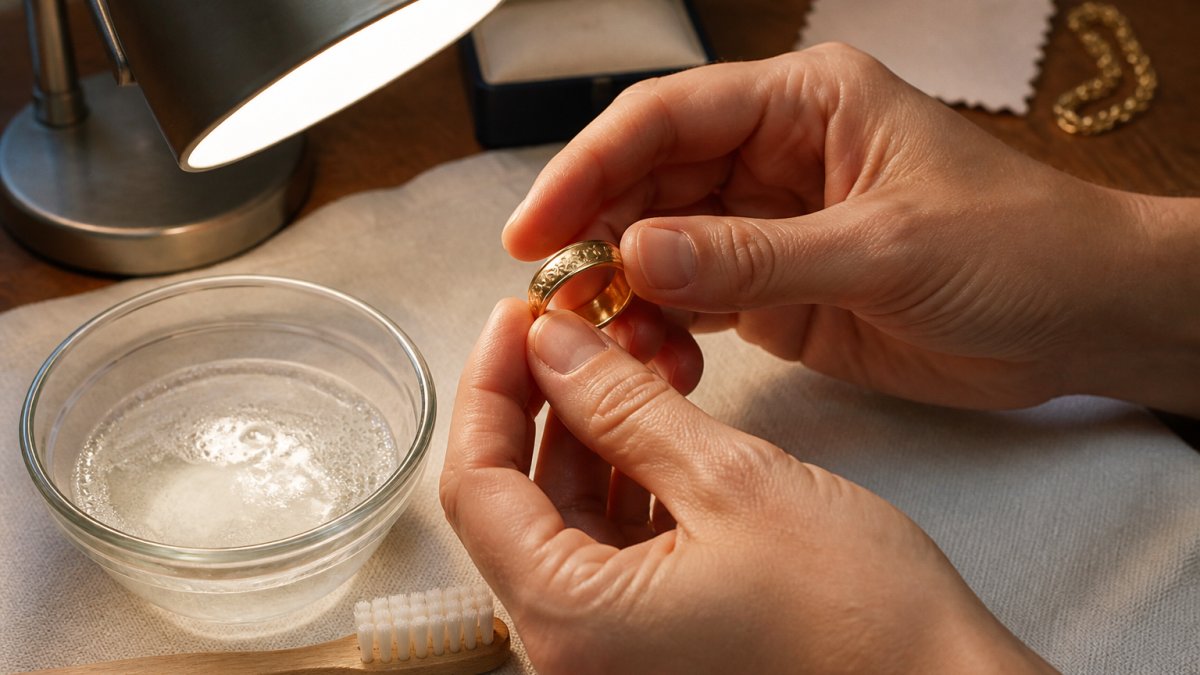
What you'll need:
- A soft brush (a baby toothbrush is ideal)
- Mild dish soap, unscented
- Two small bowls of warm water
Step 1: Dry-Brush the Loose Debris
Start dry. Brush the engraving with short strokes along the direction of the cuts, not across them, to lift dust and lint before water turns them into a paste that packs deeper.
Work over the towel so small parts don't bounce, and use light pressure, you're sweeping, not scrubbing. If the bristles bend flat against the metal, you're pressing too hard.
Step 2: Loosen What's Stuck
Add a drop of mild dish soap to one bowl of warm water. Dip the brush, shake off the excess, and work it into the grooves in small circles, letting the soapy water sit a minute to soften hardened lotion or soap film.
For stubborn spots, use a wooden toothpick at a low angle to gently lift residue from the deepest part of a letter. Wood and plastic are softer than gold and silver, so they won't gouge the metal.
Step 3: Rinse, Dry, and Check
Rinse in the second bowl of clean warm water, then blot (don't rub) with the lint-free cloth and air dry a few minutes before judging the result.
Inspect with your phone camera zoomed in or a loupe. If residue remains, repeat Step 2 once; if the grooves are clean, stop. Over-cleaning wears the finish just as surely as harsh tools do.
| Step | Time | What It Removes | Tool |
|---|---|---|---|
| Dry-brush | 2 min | Dust, lint, loose debris | Soft brush |
| Loosen | 5 min | Dried lotion, soap film | Soapy water, toothpick |
| Rinse and check | 3 min | Soap residue | Clean water, cloth |
Adjust the Method to the Metal and Finish
The steps above are the baseline.
Sterling silver. Silver is soft and tarnishes quickly.
Yellow and rose gold. Gold alloys resist tarnish but are softer than you'd expect in thin engraving.
White gold. Most white gold is rhodium-plated, and rhodium is a thin surface layer.
Plated and gold-filled pieces. Plating is measured in microns.
Oxidized or antiqued finishes. The dark recesses are intentional.
Cleaning Jewelry With a Soft Toothbrush
A soft toothbrush is the single best tool for engraved jewelry, and it costs almost nothing: the bristles reach into recessed lettering, flex against curves, and stay softer than the metal.
Pick the softest bristles you can find, baby or extra-soft adult brushes both work.
A few habits make the brush last and work better:
- Keep one brush just for jewelry so it never picks up toothpaste residue
- Trim the bristles short on an old brush to make them stiffer for deep grooves
- Rinse the brush after every use and let it dry bristle-down
For flat engraved surfaces, hold the brush at a low angle so the tips sweep the groove. For deep recessed lettering, use the very tip and short, lifting strokes.
Choosing a Jewelry Cleaning Solution for Gold and Silver
Mild dish soap and warm water handle most dirt in engravings, and they're safe on gold, sterling silver, and plated pieces.
If you want a dedicated jewelry cleaning solution for gold and silver, read the label first. Look for these traits:
- Water-based and pH-neutral. Gentle on metal and on any darkened fill.
- No ammonia or chlorine. Both attack alloys and can pit plated surfaces over time.
- No abrasives. Powders and creams with grit polish away the engraving's contrast.
- Safe for gemstones. If the piece has stones, confirm the solution is stone-safe.
Skip online home remedies: toothpaste is abrasive, bleach damages metal, and vinegar and baking soda can dull a finish.
For a deeper clean on plain sterling silver, a silver polishing cloth used gently over the engraving is a better choice than any liquid dip.
Cleaning Jewelry With an Ultrasonic Cleaner
An ultrasonic cleaner uses high-frequency vibration in a liquid bath to lift dirt from recesses.
It's also the method most likely to cause damage: the same vibration that lifts dirt can loosen stones, crack fragile settings, and strip darkened fill from engraving.
Follow these rules if you use one:
- Confirm the piece has no glued stones, pearls, opals, or soft gems
- Use only a cleaning solution made for ultrasonic baths
- Keep cycles short, and check the piece between cycles
- Skip it entirely on plated or antiqued finishes
For most engraved jewelry, a soft brush and soapy water do the job with less risk. Save the ultrasonic for plain metal bands and chains.
Tools for Narrow Grooves and What to Avoid
Fine detail needs fine tools. A brush that's too wide skips the bottom of a narrow groove, and a tool that's too hard scratches the walls around it. The right choice depends on groove width, depth, and what's stuck inside.
Match the Tool to the Groove
Measure the groove before you pick a tool. A phone macro shot next to a ruler gives you a working width. Then choose by category:
- Soft brushes in two sizes. A standard soft brush for the surface, a trimmed brush for narrow cuts. Trimming the bristles short makes them stiffer and lets the tips reach the bottom of a groove without splaying sideways.
- Wooden toothpicks. The workhorse for grooves roughly the width of a toothpick tip. Use the flat side at a low angle to lift residue; the pointed end can wedge debris tighter if you push straight down.
- Plastic brush picks. Interdental brushes and plastic detail picks reach into lettering narrower than a toothpick and won't scratch gold or silver. Choose the smallest size that still contacts the groove walls.
- Cotton swabs. Good for wetting a groove and blotting residue, poor for lifting it. The fibers shed and can leave lint behind, so follow with a dry brush.
A Practical Selection Guide
| Groove situation | Best first tool | Why |
|---|---|---|
| Wide, shallow lettering | Soft brush, full bristle | Covers area fast without pressure |
| Narrow, deep lettering | Trimmed brush, then toothpick | Stiff tips reach the bottom |
| Hairline engraving | Plastic pick, smallest size | Fits without wedging |
| Dried lotion in a curve | Toothpick flat side, then brush | Lifts without gouging |
| Loose dust only | Dry soft brush | No paste to pack deeper |
What to Avoid, and Why
- Metal pins, needles, and jeweler's files. They scratch gold and silver with light pressure, and a scratch inside a groove is permanent.
- Abrasive pads and steel wool. They flatten the surface finish and erase engraving contrast at the high points.
- Toothpaste and baking soda paste. Both are abrasive enough to dull a polish, and the grit packs into deep grooves.
- Bleach and chlorine cleaners. They attack alloys and plated layers and can pit the metal over time.
Work slowly, and check your progress with magnification between passes. The goal is to lift dirt, not to polish the metal back to new.
The single most useful upgrade for deep engraving is a trimmed soft brush plus a plastic pick. Together they cost less than a dedicated jewelry cleaner and reach grooves a full-size brush skips.
When to Hand It to a Professional Jeweler
Some jobs belong to a jeweler. If dirt won't lift after two gentle rounds, or the piece has deep settings, fragile stones, or a finish you're unsure about, stop and get help.
Book a professional cleaning when:
- The engraving still looks gray after careful brushing
- Stones are loose, glued, or of uncertain type
- The piece is plated, antiqued, or has intentional darkening you want preserved
- The metal shows scratches, dents, or wear you'd like assessed
A jeweler has the tools and training to clean without harming the finish, and many will check settings and tighten stones while they're in there, protecting the piece long term.
At Epic Gifts, our personalized pieces arrive in a mahogany-style luxury gift box, which doubles as clean, dry storage between wears.
Frequently Asked Questions
How do you remove dirt from deep jewelry engravings?
Start dry: brush loose dust out of the recessed lettering with a soft toothbrush or a stiff-bristled detailing brush, working along the groove rather than across it. Then loosen packed dirt with a drop of mild dish soap in warm water and a few minutes of soaking. Rinse with clean water, pat dry with a lint-free cloth, and inspect under bright light. Repeat gently rather than scrubbing hard, since aggressive brushing can round off fine detail in the engraving.
Can you use a soft toothbrush to clean jewelry engravings?
Yes. A soft toothbrush is one of the safest tools for cleaning jewelry with a soft toothbrush approach, especially on gold and sterling silver. Use light pressure and short strokes along the direction of the engraved lines. Avoid brushing over polished flat surfaces more than necessary, and never use an old brush with hardened or splayed bristles, which can scratch. Rinse the brush well between pieces so you don't transfer grit from one item to another.
Can an ultrasonic cleaner damage engraved jewelry?
It can. Ultrasonic cleaners are effective at lifting residue out of deep engravings, but the cavitation can loosen stones, worsen existing cracks, and dull finishes on softer metals over repeated use. Skip the ultrasonic for pieces with glued settings, pearls, opals, or emerald, and for antique jewelry with fragile solder joints. For plain gold or sterling silver bands with simple engraving, short cycles with a proper jewelry cleaning solution for gold and silver are usually fine.
When should you take engraved jewelry to a professional jeweler?
See a jeweler if the dirt won't lift after two gentle cleaning attempts, if you notice green residue or pitting that suggests corrosion, or if the piece has loose stones, deep scratches, or a finish you're unsure about. A jeweler can steam-clean, re-polish, or re-darken the lettering without damaging the surface finish. Bring the piece in before attempting wet sanding or any abrasive, since those steps are hard to reverse.
Dirt in deep engraving is a small problem with a simple fix, as long as you reach for soft tools and take your time. When you're ready to give a piece that's made to be kept and cared for, Epic Gifts offers heart-centered jewelry and personalized gifts with the packaging and quality to match the moment. Browse the collection and find something worth engraving.


