


 support@epicgifts.org
Table of Contents
- Understanding Personalized Men's Jewelry Basics
- How to Layer Men's Necklaces Without Overdoing It
- How to Mix Metals in Men's Jewelry
- Engraved Jewelry for Men Across Different Occasions
- Choosing the Right Chain Length and Style
- Caring for Your Personalized Jewelry to Maintain Its Finish
- Styling Tips for Bracelets and Rings with Personalized Pieces
- Frequently Asked Questions
Last Updated: September 20, 2026
Understanding Personalized Men's Jewelry Basics
Personalized jewelry for men transforms ordinary pieces into meaningful keepsakes. How to style personalized jewelry for men is about integrating these sentimental pieces into your everyday look with confidence and intention.
Customization adds emotional weight to what you wear. An engraved nameplate pendant or coordinates bracelet is a daily reminder of someone you love or a moment that changed your life.
Types of Personalized Pieces
Men's personalized jewelry comes in several forms: necklaces and pendants (best for layering or solo wear), bracelets with initials or dates (ideal for stacking), signet rings (perfect for making a statement), and chains (versatile base pieces that support other jewelry).
Why Customization Matters
Personalized jewelry changes how you feel and wear it. A bracelet engraved with coordinates becomes a conversation starter and personal anchor. The sentimental value makes you wear it regularly, integrating it into your actual style. Custom engraved pieces also show intentionality, the recipient knows you thought about them specifically.
How to Layer Men's Necklaces Without Overdoing It
The key to layering men's necklaces is restraint: two pieces work, three rarely do. The difference between polished and costume-like comes down to length and spacing.
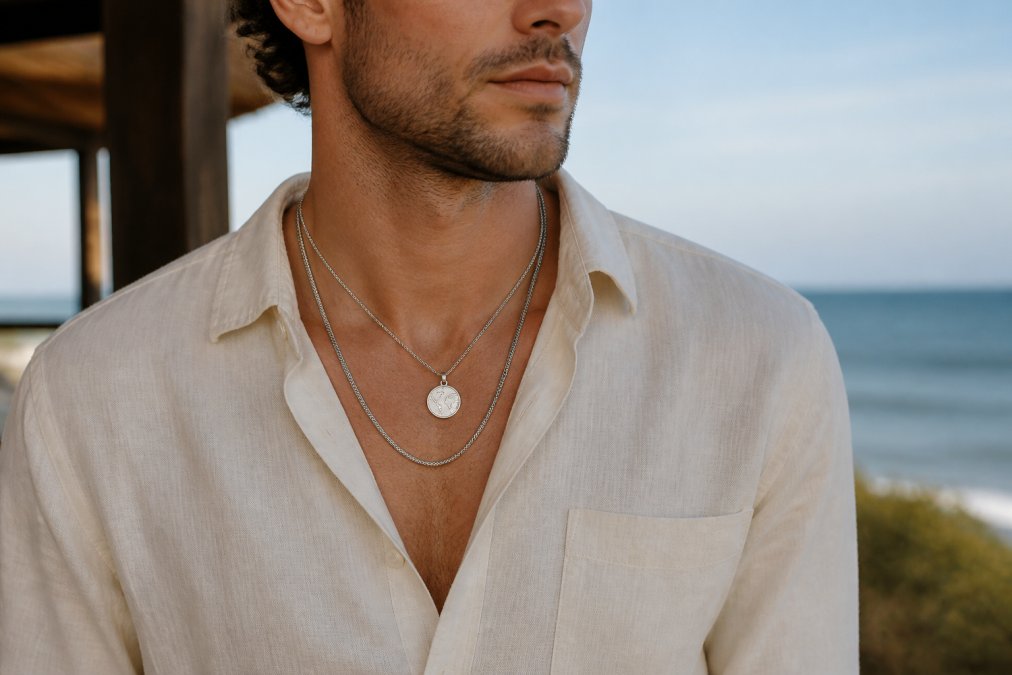
The Two-Piece Foundation
Start with two necklaces of different lengths: a shorter piece sits higher on the chest as your statement (where your engraved pendant goes), and a longer, simpler piece dangles below as a supporting player. Avoid similar lengths, they compete visually. One long, one short.
Length and Spacing Rules
Measure before layering: a short necklace sits 16-18 inches, a long piece 24-28 inches, with at least 2-3 inches of vertical space between pendants. Avoid two thick chains together, pair one delicate with one bolder for contrast.
How to Mix Metals in Men's Jewelry
The old rule, never mix silver and gold, is outdated. Men's jewelry looks better when metals work together intentionally, based on your skin tone and undertone.
Identifying Your Undertone
Your skin undertone determines which metals feel natural. Warm undertones (greenish veins) pair with gold, rose gold, and bronze. Cool undertones (blue/purple veins) pair with silver, white gold, and platinum. Neutral undertones can wear any metal but should mix same-temperature metals (both warm or both cool). Test by holding gold and silver against your wrist in natural daylight, your instinct about which looks better is usually correct.
Strategic Metal Combinations
Warm undertones: Pair yellow gold with rose gold or bronze. Avoid mixing with silver or platinum. Cool undertones: Pair silver with white gold or platinum. Avoid mixing with gold or rose gold. Neutral undertones: Mix metals only if one is clearly dominant (e.g., gold pendant with silver chain), or stick to one metal family.
Balancing Metal Finishes
Choose one dominant finish per area (shiny or matte, not both). One metal should lead; the other supports. Avoid mixing more than two metal types on your body at once. Follow the undertone rule: warm with warm, cool with cool, neutral with either but with clear hierarchy.
Engraved Jewelry for Men Across Different Occasions
How to style personalized jewelry for men changes based on where you're going. The same piece that works at a casual dinner might feel out of place in a boardroom. Understanding context matters.
Professional and Formal Settings
In professional settings, keep personalized jewelry minimal: one piece is better than two. Avoid anything that catches light aggressively or swings. For formal events, wear a signet ring and watch only; hide necklaces under your shirt. For business casual, a visible pendant or nameplate bracelet works if it looks deliberate. Avoid dangling pendants in formal settings.
Casual and Everyday Wear
Casual settings let personalized jewelry shine: layer necklaces, stack bracelets, mix metals. Everyday wear is about pieces you notice and feel, an engraved bracelet with coordinates becomes part of your daily armor. Let your pieces be seen; they tell your story.
Choosing the Right Chain Length and Style
Chain length determines how a pendant sits and interacts with your body and outfit. Getting this right makes the difference between a piece that feels intentional and one that feels awkward.
Measuring and Fit
For most men, 18-22 inches is ideal (sits above chest, works with most necklines). Longer chains (24-30 inches) are more relaxed and visible. Thicker necks need longer chains; slimmer necks can wear shorter pieces. Test by wearing it, if the pendant swings awkwardly or catches on buttons, the length isn't right.
Link Styles and Aesthetics
Curb chains are classic and versatile. Rope chains work with heavier pendants. Box chains are sleek and modern. Match chain weight to pendant: delicate nameplate on delicate chain, chunky signet on bolder chain. Let one element be the star; the chain should support, not compete.
Caring for Your Personalized Jewelry to Maintain Its Finish
Personalized pieces deserve care beyond what generic jewelry requires. The engraving itself won't fade or disappear, but the metal finish can dull, tarnish, or wear in ways that make custom details less sharp and visible. Understanding the difference between caring for engraved surfaces and plated finishes is essential for keeping personalized pieces looking intentional and new.
Daily Maintenance for All Personalized Jewelry
Remove your jewelry before bed. Sleeping in jewelry causes unnecessary wear. It catches on sheets, gets bent out of shape, and experiences pressure that can loosen settings or damage plating. Taking it off adds five seconds to your routine and extends the life of your pieces significantly.
Wipe your jewelry daily with a soft, dry cloth. This removes skin oils, sweat, and environmental residue that dull the finish. A microfiber cloth or soft cotton cloth works best. Avoid paper towels or rough fabrics that can scratch. This quick wipe takes seconds and prevents buildup that accelerates tarnishing.
Avoid water and chemicals. Shower, swimming, and chlorine damage most metals and accelerate plating wear. Remove your pieces before getting wet. Soap, shampoo, hand lotion, cologne, and sunscreen leave residue that discolors finishes and can seep into engravings. These small exposures add up over time and are the primary cause of premature finish degradation.
Protecting Engraved Details Specifically
Engraved surfaces require extra attention because the custom details are recessed into the metal. Aggressive cleaning can smooth the edges of the engraving and make text or designs less sharp and legible over time.
Never use abrasive cloths, brushes, or cleaning compounds on engraved areas. Avoid jewelry cleaning cloths with polishing compounds, ultrasonic cleaners, or steam cleaners for engraved pieces.
Caring for Plated Jewelry
Plated jewelry, where a thin layer of precious metal (gold, silver, or platinum) is bonded to a base metal, requires different care than solid metal pieces. The plating can wear through with improper handling, potentially exposing the base metal underneath.
Solid Metal Jewelry Care
Solid gold, solid silver, and solid platinum pieces are generally more durable than plated jewelry and may require less frequent professional maintenance.
When to Seek Professional Help
If personalized jewelry shows any of these signs, scheduling a professional cleaning or inspection may be beneficial:
- Visible tarnish or discoloration that doesn't wipe away with a soft cloth
- Dull or cloudy finish that doesn't respond to gentle cleaning
- Worn or blurred engraving where text or designs are no longer sharp
- Plating that's visibly wearing through, exposing a different-colored base metal
- Loose settings or damaged links that affect the piece's integrity
Styling Tips for Bracelets and Rings with Personalized Pieces
Bracelets and rings add dimension to your personalized jewelry collection. Layering them requires the same restraint as necklaces but offers more flexibility because they're further from your face.
Frequently Asked Questions
How do you wear personalized jewelry without looking overdone?
The key is restraint and intentional spacing. Start with one focal piece, a nameplate pendant or engraved signet ring, and add complementary items sparingly. If layering necklaces, vary the lengths by at least 2 inches so they sit at different points on your chest. Avoid mixing more than two metals unless they're intentionally coordinated (like gold and rose gold). Keep other accessories minimal when wearing statement personalized jewelry. Your engraved piece should be the story; everything else supports it.
Can you mix metals when wearing personalized men's jewelry?
Yes, mixing metals works when done thoughtfully. The trick is choosing metals with similar undertones, warm golds pair well together, while silver and platinum create a cohesive cool-toned look. Consider your skin tone: warm undertones suit gold and rose gold, while cool undertones favor silver and white gold. You can also intentionally mix metals as a modern aesthetic choice, but keep the rest of your styling minimal and coordinated. Avoid random mixing that looks accidental rather than intentional.
What should I engrave on personalized men's jewelry?
Engraved jewelry for men works best with meaningful but subtle personalization. Initials, a significant date, coordinates of a meaningful location, or a short meaningful word all work well. For nameplate pendants, a first name or nickname is classic. Avoid overly long phrases that clutter the piece or become difficult to read. The engraving should feel like a personal secret rather than a billboard, something the wearer knows is there and that carries sentimental weight. Consider what will remain relevant and meaningful years from now.
How do I know if personalized jewelry will last and not tarnish quickly?
Durability often depends on the material quality and care routine. Materials like sterling silver, gold vermeil, and stainless steel can be durable choices that resist tarnishing when properly maintained. It's advisable to check that any personalized piece uses quality materials and finishes. Storing jewelry in a dry place, cleaning it regularly with a soft cloth, and avoiding exposure to harsh chemicals or excessive moisture can help maintain its condition. High-quality personalized jewelry, when cared for properly, can hold up well for years, making it a lasting investment in a meaningful gift.
Personalized jewelry works best when it feels like part of who you are, not something you're wearing. The pieces from Epic Gifts are designed to become part of your daily routine, meaningful, durable, and styled with intention. Start with one quality piece. Learn how it feels on your body. Then add thoughtfully. Your personalized jewelry should tell your story without shouting it. That's when it becomes truly valuable.


