


 support@epicgifts.org
Table of Contents
- What Makes Personalized Jewelry Ethically Sourced
- How to Verify Ethical Jewelry Sourcing
- Sustainable Personalized Jewelry Brands Worth Your Attention
- Key Features to Look for in Ethically Sourced Personalized Jewelry
- Why Personalization Transparency Matters
- Making Your Purchase Decision
- Frequently Asked Questions
Last Updated: September 27, 2026
What Makes Personalized Jewelry Ethically Sourced
Ethically sourced personalized jewelry combines transparency about material sourcing with customization reflecting individual values. The gold comes from responsible mining, gemstones are conflict-free, and artisans earn fair wages.
Ethically sourced personalized jewelry carries accountability at every step: you know who mined the metal, the gemstone's origin, and that artisans weren't exploited.
At Epic Gifts, we believe meaningful gifts deserve meaningful sourcing. Our personalized jewelry uses materials you can trust, where the story behind each piece adds to its value.
Key markers of ethical sourcing: recycled precious metals, conflict-free gemstones with verified documentation, fair wage certifications, and transparent production methods. Small-batch and artisan-made pieces offer stronger ethical credentials because the entire supply chain is visible and traceable.
How to Verify Ethical Jewelry Sourcing
Verification requires looking beyond marketing language to distinguish genuine ethical sourcing from greenwashing.
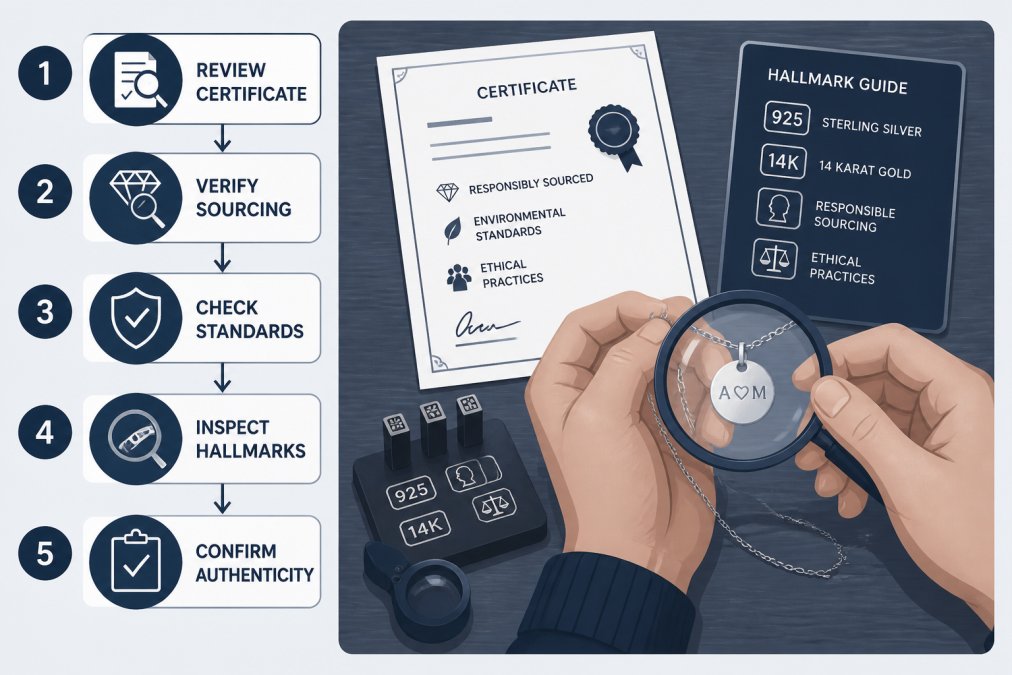
Look for Sustainability Certifications
Third-party certifications carry weight because they're independently verified. B Corp certification confirms rigorous environmental and social standards. Fairmined verifies responsible gold mining with fair wages. RJC certification confirms ethical practices across the supply chain.
Not all certifications are equally rigorous. Check what each covers, a brand might be certified for gold sourcing but not gemstone origin. Reputable sellers display credentials prominently with verification links.
Legitimate certifications include links to the certifying organization for independent verification. If documentation isn't available, ask before purchasing.
Check for Traceability and Supply Chain Transparency
Supply chain transparency means following materials from source to finished piece. Brands should explain where precious metals and gemstones came from, ideally naming specific mines or artisan cooperatives.
Request documentation before purchasing. Ask for certificates of origin or recycling sources. Honest sellers answer with specifics, not generalities.
Red flags: brands that can't provide sourcing details or use vague language like "responsibly sourced" without specifics. Transparency is fundamental to ethical sourcing.
Identify Greenwashing Red Flags
Greenwashing uses ethical language without backing it up: claiming "sustainable" or "conflict-free" without certifications, or highlighting one practice while ignoring others.
Watch for: brands emphasizing sustainability without certifications, "conflict-free" claims lacking verification, vague sourcing statements, or marketing that ignores labor practices.
The best defense against greenwashing is asking direct questions and requesting proof. Confident brands provide documentation; defensive ones are likely hiding something.
Sustainable Personalized Jewelry Brands Worth Your Attention
Finding where to buy ethically sourced personalized jewelry means identifying brands with transparent sourcing and proven ethical practices.
Brands Using Recycled Precious Metals
Recycled gold and silver eliminate mining impact. Aurate specializes in 100% recycled gold with personalized engraving. Ana Luisa uses recycled metals with carbon-neutral operations. Linjer combines recycled metals with ethically sourced diamonds.
Recycled metals perform identically to newly mined gold and work perfectly for engraving and custom designs.
Brands Focused on Conflict-Free Gemstones
Conflict-free gemstones carry documentation proving they didn't fund armed conflict. Brilliant Earth specializes in traceable gemstones with full documentation. Vrai uses lab-grown diamonds with recycled gold. Gardens of the Sun sources gemstones with full traceability.
Lab-grown diamonds are chemically identical to mined diamonds but produced without mining impact, offering the same durability at lower environmental cost.
Artisan-Made and Small-Batch Producers
Small-batch production makes the entire supply chain visible and traceable. Catori Life emphasizes artisan craftsmanship. Article 22 supports artisan livelihoods in Laos with fair trade practices. Gardens of the Sun operates with B Corp certification and full transparency.
Artisan-made pieces carry stories and ensure fair wages for craftspeople. Small-batch production means your piece is genuinely unique.
Key Features to Look for in Ethically Sourced Personalized Jewelry
Beyond the brand itself, specific features signal genuine ethical commitment. These details matter when comparing options and understanding the true value of your investment.
Fair Wage and Labor Practices
Fair wages mean artisans earn enough to support their families without exploitation. Brands should disclose wage structures or hold certifications (Fairmined, Fair Trade Certified). Some name their artisans or cooperatives for accountability.
Ask about production locations and worker conditions: Are artisans paid per piece or hourly? Do they receive benefits? Can the brand provide documentation?
Look for brands publishing wage transparency reports or partnering with labor auditors. Some list individual artisans' names and workshop locations on product pages.
Repair and Circularity Services: The Overlooked Pillar of Sustainability
Repair and buy-back programs are critical for sustainability but rarely discussed. A piece lasting 50 years carries dramatically lower environmental impact than one worn five years and discarded.
Why repair services matter ethically:
Jewelry degrades with wear. Without repair options, pieces are discarded or sit unworn. Repair services extend lifespan and amortize environmental costs across decades.
What to look for in repair offerings:
Ask sellers: Do you offer lifetime repair services? What repairs are covered (resizing, stone replacement, clasp repair, refinishing)? What is the turnaround time and cost? Can you repair personalized pieces? Do you accept pieces for recycling or buy-back?
Circularity programs:
Buy-back and recycling programs close the loop, ensuring materials re-enter the supply chain rather than landfills. Some offer store credit (25-50% of original price), incentivizing upgrades while recovering materials.
Precious metals are infinitely recyclable without quality loss. Brands offering recycling prove commitment to circular economy principles.
Durability as an ethical feature:
Brands serious about sustainability design for longevity: using solid precious metals, selecting durable gemstones and settings, offering sizing adjustments, providing care instructions, and standing behind craftsmanship with warranties.
Eco-Friendly Packaging and Shipping
Ethical brands minimize packaging, use recycled materials, and offer carbon-neutral shipping. Excessive plastic or non-recyclable materials contradict sustainability claims.
Some brands use compostable mailers and recycled cardboard. Others offset shipping emissions through verified carbon programs. These details matter for the complete ethical picture.
Why Personalization Transparency Matters
The personalization process carries ethical weight most guides overlook.
True personalization involves various methods, each with its own considerations for labor and transparency.
How to verify the personalization process:
Ask sellers these specific questions before purchasing:
- "Is this piece made to order, or do you engrave existing inventory?" Made-to-order indicates genuine customization; existing inventory suggests dropshipping.
- "Who performs the personalization, your in-house team or a third party?" In-house is more transparent; third-party requires follow-up verification.
- "Can you provide photos or a video of the personalization process for my piece?" Ethical brands document this. If they can't or won't, the customization is likely minimal.
- "What is the lead time for personalization?" Longer lead times (2-4 weeks) suggest made-to-order; immediate turnaround suggests pre-made inventory.
- "If I request a change to the personalization after ordering, can you accommodate it?" Made-to-order pieces are flexible; dropshipped items with pre-applied engravings are not.
- "Can you provide the name or location of the artisan or workshop that creates this piece?" Transparency here proves the supply chain is traceable.
Red flags appear when brands:
- Use vague language like "expertly personalized" without explaining the method
- Offer personalization with no lead time (suggesting engravings are added to stock)
- Cannot or will not name the workshop or artisan involved
- Refuse to provide process photos or documentation
- Claim personalization is available for any design instantly (impossible for genuine made-to-order work)
Making Your Purchase Decision
Start by defining what matters most to you. Are recycled metals your priority? Conflict-free gemstones? Artisan support? Fair wages? Fair trade certification? Your values shape which brands align with your needs.
| Feature | What to Look For | Red Flags |
|---|---|---|
| Precious Metals | Recycled gold/silver or certified sustainable sources | No sourcing information provided |
| Gemstones | Conflict-free certification or lab-grown | "Ethically sourced" without documentation |
| Labor Practices | Fair wage certification or named artisans | Vague statements about worker treatment |
| Customization | Made-to-order with explained process | Generic items with engravings added |
| Transparency | Detailed sourcing documentation available | Marketing language without proof |
| Durability | Quality materials, repair services offered | Cheap materials, no warranty |
Frequently Asked Questions
What certifications should I look for when buying ethically sourced personalized jewelry?
Look for B Corp certification, which verifies third-party sustainability standards; Fairmined certification for responsibly mined gold; Responsible Jewellery Council (RJC) membership; and lab-grown diamond certifications from the Gemological Institute of America (GIA). These certifications confirm that a brand meets rigorous environmental and labor standards. Ask brands directly for their certifications and don't assume marketing claims without third-party verification.
How can I verify if a jewelry brand is truly sustainable and ethical?
Check the brand's supply chain transparency reports, which should detail where materials come from and how workers are treated. Look for specific claims backed by certifications rather than vague promises. Contact the brand directly with questions about sourcing, labor practices, and environmental impact. Authentic brands provide detailed answers and documentation. Avoid brands that use terms like 'sustainable' or 'ethical' without concrete evidence or third-party verification.
What makes personalized jewelry ethically sourced differently than mass-produced pieces?
Ethically sourced personalized jewelry often involves smaller production batches and artisan craftsmanship, allowing for better oversight of labor practices and material sourcing. Small-batch production reduces waste and allows brands to verify every step of creation. However, personalization alone doesn't guarantee ethics, verify that the brand uses recycled metals, conflict-free gemstones, and fair labor practices throughout the customization process to ensure true ethical sourcing.
Are recycled metals considered ethical in jewelry making?
Yes, recycled gold, silver, and platinum are considered more ethical than newly mined metals because they avoid the environmental damage and labor concerns associated with mining. Recycled metals require less energy to process and eliminate the risk of conflict diamonds or unethically sourced gemstones. Many ethical jewelry brands now use 100% recycled precious metals as a core part of their sustainability commitment, making them a responsible choice for personalized pieces.


