


 support@epicgifts.org
Table of Contents
- Custom Initial Jewelry vs Name Necklaces: Key Differences
- Name Necklace Chain Length Guide: Finding the Right Fit
- Durable Materials for Custom Jewelry That Lasts
- Gold vs Sterling Silver: Which Metal Suits Your Gift?
- The Best Personalized Necklaces for Gifts by Occasion
- Styling and Layering: Making Initials and Names Work Together
- Frequently Asked Questions
Last Updated: September 14, 2026
Custom Initial Jewelry vs Name Necklaces: Key Differences
Custom initial jewelry is a personalized accessory featuring one or more letters, while a name necklace spells out a full name or word. The choice between them comes down to how much you want to say and how you want to say it. An initial keeps things subtle and universal; a name makes the piece unmistakably about one person.
The practical differences matter more than the philosophical ones. Initials suit layering, daily wear, and recipients whose taste you're less sure about. Name necklaces make a bolder statement and work best when the name is short and the recipient loves attention.
| Feature | Initial Jewelry | Name Necklaces |
|---|---|---|
| Character count | 1-3 letters | 2-10 characters |
| Visual weight | Dainty, understated | Bolder, statement piece |
| Layering fit | Excellent | Moderate |
| Personalization depth | Subtle | Explicit |
| Best for | Daily wear, uncertain taste | Milestone gifts, confident style |
Both formats support custom engraving on the reverse, which is where most buyers hide a date or short message.
Name Necklace Chain Length Guide: Finding the Right Fit
Chain length decides where a necklace sits and how it reads against your neckline. The most common lengths run from 16 to 20 inches, and each lands somewhere different. A 16-inch chain sits at the base of the throat, which suits dainty pendants and high necklines. An 18-inch chain rests on the collarbone and is the safest default for most recipients. Twenty inches drops below the collarbone and pairs well with a nameplate necklace that needs room to breathe.
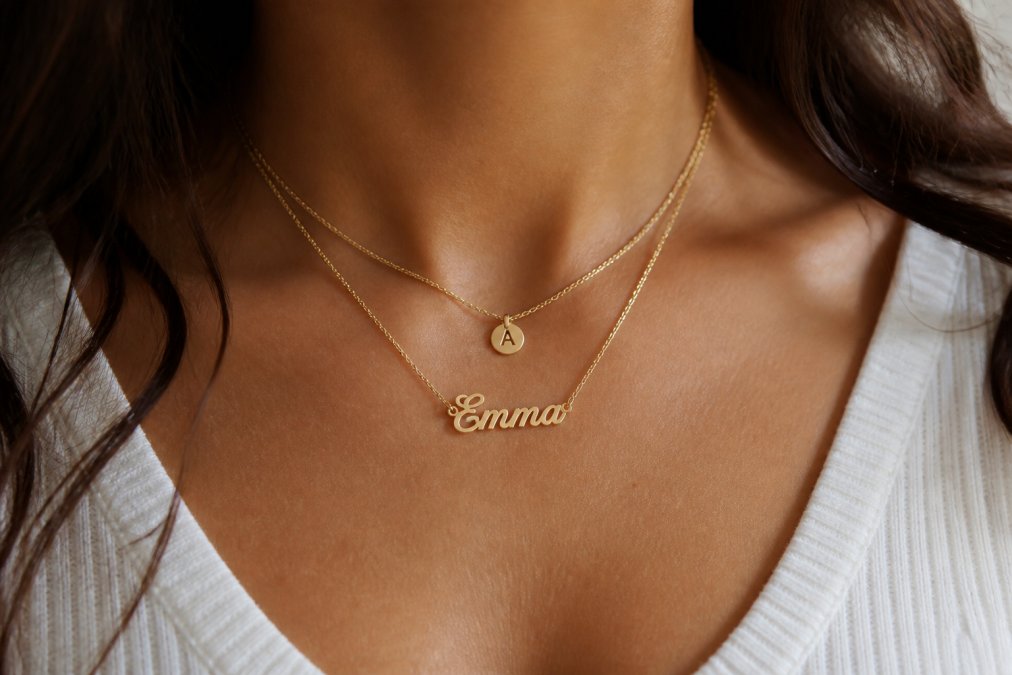
For layering, keep at least 2 inches between chains so they don't tangle. A 16-inch initial pendant over an 18-inch nameplate creates a clean two-tier stack. Anything closer and you'll spend more time untangling than wearing.
Durable Materials for Custom Jewelry That Lasts
Durability comes down to the base metal, the finish, and how the piece is worn. Sterling silver is a solid 92.5% silver alloy that resists tarnish when cared for and holds up to daily wear (What is sterling silver?). Gold plating over a sterling silver base gives you the look of gold at a lower cost, but plating wears over time, especially on pieces worn daily.
Solid 14k gold is a durable option for a piece you intend to keep for decades. It won't flake or fade because the gold runs through the entire piece rather than sitting on the surface.
Look for these markers when comparing options:
- 925 sterling silver stamp on the clasp or tag
- 14K or 18K hallmark for solid gold
- Tarnish-resistant finish on plated pieces
- Reinforced clasp rather than a thin spring ring
Waterproof claims deserve scrutiny. Most plated jewelry survives occasional splashes but not daily showering or swimming. Solid gold and sterling silver handle moisture far better.
Gold vs Sterling Silver: Which Metal Suits Your Gift?
Gold and sterling silver are both precious metals, but they differ in composition, how they age, and what they signal, and those differences should drive the choice more than color preference alone.
What each metal actually is. Sterling silver is a solid alloy of 92.5% silver and 7.5% other metals, usually copper, added for strength. Because it's solid throughout, it can be polished back to brightness again and again. Solid gold is measured in karats: 14k gold is roughly 58% gold mixed with alloys, and 18k is about 75% gold (the FTC). The higher the karat, the richer the color and the softer the metal.
How they age. Sterling silver tarnishes. That's not a defect, it's a reaction between the silver and sulfur compounds in air, and it shows up as a dark film that polishes off (pubmed.ncbi.nlm.nih.gov). Solid gold doesn't tarnish, so it stays the same color for decades with almost no effort. Plated and vermeil pieces sit in between: the gold layer wears thin over time, especially at the points where the piece rubs against skin, clothing, or other jewelry.
The durability-versus-price trade-off. This is where most buyers get stuck. A common pattern is:
-
Plated over base metal: Lowest cost, shortest life. Best for a trend piece or a first trial, not for daily wear.
-
Sterling silver: Mid cost, long life with occasional polishing. Hypoallergenic, which matters for sensitive skin.
-
Solid 14k or 18k gold: Highest cost, longest life. The choice for a piece meant to be worn daily for decades or passed down.
How to read the marks. Look for a 925 stamp on sterling silver and a 14K or 18K hallmark on solid gold. A reinforced clasp rather than a thin spring ring extends the life of any chain.
Water and wear. Most plated jewelry survives occasional splashes but not daily showering, swimming, or workouts. Sterling silver and solid gold handle moisture far better, though chlorine and salt water are still worth avoiding for any piece. If the recipient never takes their jewelry off, solid gold is the lower-regret choice; if they rotate pieces and store them dry, sterling silver or vermeil will serve well for years.
What each metal signals. Gold, whether yellow, white, or rose, reads as warm and traditional, and rose gold carries a softer, more modern tone that pairs well with dainty pendants. Sterling silver reads cooler and more contemporary and costs less at the same size. For an anniversary, gold tends to carry more weight as a lasting token. For a birthday or a first personalized piece, sterling silver is a sensible starting point. If the recipient already wears one metal consistently, match it, mixing metals works stylistically, but matching removes the guesswork.
The Best Personalized Necklaces for Gifts by Occasion
The best personalized necklaces for gifts depend on the occasion and how much sentiment you want the piece to carry. The deeper question is who the recipient is to you, because that relationship determines whether an initial or a full name communicates the right thing.
A single initial works like a private shorthand. It says "I thought of you" without announcing the name to everyone who sees it. That makes it the safer choice for a coworker, a new partner, or anyone whose taste you're still learning. A full name is explicit and public. It says "this is about you specifically," which is why it lands hardest with someone who enjoys being the center of attention or who has a name they love.
Here's how that plays out across common occasions:
- Anniversaries: A solid gold initial or a name necklace engraved with a shared date carries the most weight. Couples often choose each other's initials on separate chains so the pair reads as a set without being identical.
- Mother's Day: Multiple initials representing children, arranged along a single bar or spread across a chain, is the standard move. A common pattern is one initial per child in birth order, which turns the piece into a small family tree the wearer can read at a glance.
- Birthdays: A bubble-style initial charm or a short name necklace suits younger recipients. Keep the name short, three to five letters, because longer names on a small pendant get cramped and hard to read.
- Graduations: A name necklace is the natural fit, since the name is the point and the milestone is about the person stepping forward.
- New babies and christenings: A single initial that a parent wears until the child grows into it is the classic choice. It doubles as a keepsake the child can inherit later.
- Just because: A single initial. No occasion needed, and no risk of overstating the relationship.
A quick way to decide: match the personalization depth to the relationship. The closer and more permanent the bond, the more a full name makes sense. The newer or more uncertain the relationship, the more an initial protects you from guessing wrong.
Styling and Layering: Making Initials and Names Work Together
Initials and name necklaces layer best when you vary the weight and length of each piece. A dainty initial pendant on a shorter chain sits above a longer nameplate necklace without competing. The contrast in scale is what makes the stack look intentional rather than cluttered.
Three rules keep a layered stack clean:
- Vary length by at least 2 inches between chains
- Vary weight so one piece anchors and the others accent
- Cap it at three necklaces before the stack reads as noise
A minimalist aesthetic makes layering easier. Thin chains, small pendants, and consistent metal tones create a stack that works with everything from a t-shirt to a blouse. If you're layering a statement piece, give it room and keep the rest quiet.
Choosing between custom initial jewelry and a name necklace is really a question of how you want the recipient to feel when they open the box. The right piece matches their style, survives daily wear, and arrives ready to give. Epic Gifts offers heart-centered personalized jewelry, durable materials, and mahogany-style luxury gift box packaging so the presentation matches the sentiment. Free shipping applies on orders over $70. Get started with Epic Gifts and find a piece that says what you mean.
Frequently Asked Questions
Should an initial necklace be your first or last name?
It depends on the message you want to send. A first initial feels personal and intimate, often chosen for a partner or child. A last-name initial signals family pride and works well for parents or grandparents. Many people wear a single initial that represents a shared surname. If you are giving a gift, consider which name the recipient uses most in daily life, and choose that initial for a meaningful connection.
Are nameplate necklaces still in style in 2026?
Yes. Nameplate necklaces have moved from a trend piece to a wardrobe staple. Modern versions use dainty script fonts, sterling silver, or 14k gold, which keeps them looking current. Layering a nameplate with a shorter initial pendant is a popular way to wear them now. The key is choosing a font and metal that match the recipient's existing jewelry so the piece feels intentional rather than dated.
What is the difference between initial jewelry and name necklaces?
Initial jewelry features one or a few letters, often a single monogram or a pair of initials. Name necklaces spell out a full name or word, usually in script or block lettering. Initial pieces tend to be smaller and more subtle, while name necklaces make a bolder personal statement. Both can be made from durable materials like sterling silver or 14k gold, and both work as anniversary or birthday gifts.
Which personalized necklace style is more versatile for daily wear?
A single-initial pendant on a 16 to 18 inch chain is the most versatile for daily wear. It sits close to the collarbone, layers easily with other necklaces, and does not tangle. Name necklaces can also be worn daily, but longer names may catch on clothing or feel heavier. If the recipient wears delicate jewelry, start with an initial piece and add a name necklace for special occasions.
Will personalized jewelry tarnish or fade over time?
Sterling silver and 14k gold resist tarnishing far better than plated or base-metal options. Plated pieces can fade with sweat, perfume, and water exposure, so they need more care. Look for tarnish-resistant materials if the recipient plans to wear the piece daily. Storing jewelry in a dry pouch and removing it before swimming or showering will extend its life, regardless of the metal you choose.


