


 support@epicgifts.org
Table of Contents
- Quick Comparison: 5 Durable Wedding Band Metals
- Tungsten Carbide: Scratch Resistant Wedding Bands That Hold Their Polish
- Titanium: Lightweight Strength for Active Lifestyles
- Tungsten vs Titanium Durability: Which One Actually Lasts Longer?
- Platinum: The Heaviest, Most Repairable Precious Metal
- 14k Gold: Yellow and White Options That Jewelers Can Actually Fix
- Hypoallergenic Wedding Ring Metals for Sensitive Skin
- Conclusion: Match the Metal to the Life You Actually Live
- Frequently Asked Questions
Last Updated: September 16, 2026
Quick Comparison: 5 Durable Wedding Band Metals
Choosing among the 5 best metals for durable wedding bands comes down to one trade-off: hardness versus repairability, and that is exactly what makes durable wedding bands so hard to pick. Tungsten carbide and titanium resist scratches better than anything else on this list, while platinum and 14k gold sacrifice some surface hardness in exchange for the ability to be resized, polished, and repaired for a lifetime.
Here's the short version before the detail:
| Metal | Scratch Resistance | Resizable | Relative Cost | Best For |
|---|---|---|---|---|
| Tungsten carbide | Highest | No | Lowest | Active hands, low maintenance |
| Titanium | High | Difficult | Low | Weightless feel, water exposure |
| Platinum | Moderate | Yes | Highest | Heirloom wear, stone security |
| 14k yellow gold | Moderate | Yes | Mid | Tradition, easy repair |
| 14k white gold | Moderate | Yes | Mid | Neutral look, matching jewelry |
Tungsten Carbide: Scratch Resistant Wedding Bands That Hold Their Polish
Tungsten carbide is the hardest metal commonly used in wedding bands, and it keeps a mirror polish longer than any precious metal. Its scratch resistance comes from extreme hardness on the Mohs hardness scale, which is why scratch resistant wedding bands almost always means tungsten in practice. The trade-off is brittleness: a hard ring can crack under a sharp impact rather than bend.
The Resizing Problem No One Mentions
Most ring-shopping guides skip the resizing question entirely. That's a mistake. Gold and platinum can be cut, stretched, or re-soldered by any competent jeweler. Tungsten and titanium generally cannot, because their hardness makes traditional resizing impractical. If you expect your finger size to change, that limitation should drive your decision more than scratch resistance does.
Titanium: Lightweight Strength for Active Lifestyles
Titanium is the lightest durable option here, and many wearers forget they have it on within a day. It has a high strength-to-weight ratio, resists corrosion from salt water and chlorine, and is biocompatible, which makes it a natural fit for people who swim, train, or work with their hands. The catch is surface wear: titanium develops fine scratches over time, and those scratches can be polished out only with difficulty.
Tungsten vs Titanium Durability: Which One Actually Lasts Longer?
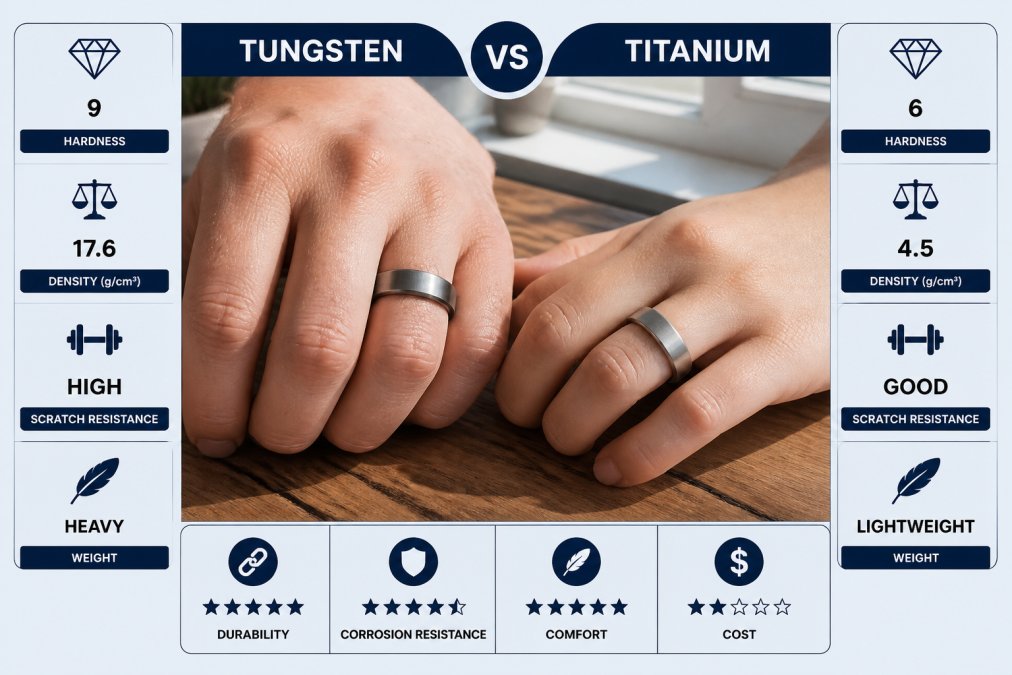
Tungsten carbide wins on scratch resistance; titanium wins on impact toughness. That's the honest answer to the tungsten vs titanium durability question. Tungsten is roughly four times harder than titanium, so it holds its finish far better, but its brittleness means a hard knock can crack it. Titanium bends and dents instead of shattering, but it scratches more readily. Neither metal can be resized, so both demand you get the size right the first time.
Platinum: The Heaviest, Most Repairable Precious Metal
Platinum is the densest metal on this list, and that weight is the point. Its density means metal displaces rather than wears away, so a platinum band loses very little material over decades of daily wear, and it never needs rhodium plating to stay white. It is naturally hypoallergenic, and jewelers can resize, re-polish, and re-tip it indefinitely. The cost is the highest of the five, driven by rarity and density.
What "Platinum" Actually Means on a Ring
Most wedding bands sold as platinum in the United States are stamped "PLAT" or "950," meaning the alloy is 95% pure platinum with the remaining 5% made up of other platinum-group metals such as iridium, ruthenium, or cobalt. That 950 standard is the common benchmark for jewelry-grade platinum, and it is why platinum rings feel noticeably heavier in the hand than a gold band of the same width.
Why Platinum Is the Most Repairable Option Here
Platinum's reputation for repairability is not marketing, it is metallurgy. Because platinum is dense and highly malleable, a jeweler can cut a band, add or remove a small section of matching 950 alloy, and re-solder it with a platinum-specific torch setup. The seam is then burnished and polished so the repair is effectively invisible. The same process works for re-tipping prongs on a stone-set band, rebuilding a worn edge, or restoring a brushed finish.
The Cost Reality
Platinum is priced by the troy ounce on global metals markets, and its spot price has historically traded both above and below gold depending on the year. On top of the metal cost, platinum is harder to work than gold, so labor charges for sizing and repairs tend to run higher. Expect a platinum band to cost meaningfully more than a comparable 14k gold band at the same width and finish.
14k Gold: Yellow and White Options That Jewelers Can Actually Fix
14k gold is an alloy of pure gold with other metals, which gives it more scratch resistance than softer, higher-karat gold while keeping the traditional warmth buyers expect. Yellow and white versions behave differently. Yellow 14k gold never needs plating and resists tarnishing. White 14k gold is finished with rhodium plating for a bright, silver-like look, and that plating wears off over time and needs periodic renewal.
What 14k Actually Contains
In the United States, "14k" means the alloy is 14 parts gold out of 24, or roughly 58.3% pure gold by weight. The remaining 41.7% is a mix of metals chosen to give the alloy its color and working properties. Yellow 14k gold typically uses copper and silver or zinc in the alloy, which produces the warm yellow tone and makes the metal resistant to tarnishing without any surface treatment.
Skin Chemistry and the Nickel Question
Nickel is the most common cause of contact dermatitis from jewelry, and it is also one of the most common alloying metals in white gold. A common pattern is that a wearer has no reaction for the first year or two, then notices itching, redness, or a faint dark ring on the finger once the rhodium plating has thinned enough to expose the underlying alloy.
- Choosing yellow 14k gold, which typically does not use nickel in its alloy
- Asking the jeweler for nickel-free white gold, often alloyed with palladium instead
- Choosing platinum or titanium, both of which are naturally nickel-free
- Planning for rhodium re-plating every 12 to 24 months on white gold, which restores both the color and the barrier between your skin and the alloy
Resizing and Long-Term Repair
Gold's advantage over tungsten and titanium is that it can be cut, stretched, and re-soldered by any competent jeweler. A 14k gold band can typically be sized up or down by one to two full sizes without structural compromise, and a skilled bench jeweler can add a sizing bar or a hinged shank for larger adjustments. Polishing removes surface scratches and restores the original finish, and a worn band can be re-tipped, re-shanked, or rebuilt over time.
Yellow 14k gold is the lowest-maintenance precious-metal option on this list: no plating, no nickel exposure in most alloys, and full repairability. White 14k gold gives you the same repairability but adds a recurring plating cost and a skin-chemistry variable that sensitive wearers should weigh carefully.
Hypoallergenic Wedding Ring Metals for Sensitive Skin
Hypoallergenic wedding ring metals are those that avoid nickel, the most common cause of skin reactions in jewelry. Platinum, titanium, and tungsten carbide are all naturally hypoallergenic. Yellow gold is generally safe because its alloy mix rarely triggers reactions, but white gold can contain nickel under its rhodium plating, and once that plating wears thin, sensitive wearers may notice irritation.
Skin chemistry matters as much as metal hardness. A ring that scratches easily but never irritates you will get worn far more than a scratch-proof ring you have to take off.
Conclusion: Match the Metal to the Life You Actually Live
The right metal is the one that fits how you use your hands, not the one with the best spec sheet. Tungsten and titanium suit active, low-maintenance wearers who accept that resizing is off the table. Platinum and 14k gold suit anyone who wants a ring a jeweler can repair, resize, and pass down.
Frequently Asked Questions
What is the most durable metal for a wedding ring?
Tungsten carbide wins on scratch resistance. It measures 8-9 on the Mohs hardness scale, so it keeps its polish far longer than gold or platinum. Platinum is the most durable precious metal because its high density means metal shifts rather than wears away. Titanium offers the best strength-to-weight ratio. The right pick depends on whether you value a scratch-free surface or a ring a jeweler can repair and resize later.
Is platinum more durable than gold for wedding bands?
Yes. Platinum is denser and more scratch-resistant than 14k gold, and it does not lose metal when scratched, it just displaces. It also stays naturally white without rhodium plating. Gold is softer and needs periodic polishing, but it is easier and cheaper to resize. If long-term wear matters most, platinum holds up better. If budget and repairability matter, gold is the practical choice.
What are the pros and cons of tungsten wedding bands?
Tungsten carbide is four times harder than titanium, virtually scratch-proof, and starts around $150, making it the most affordable durable option. The downsides matter just as much: tungsten cannot be resized, and its brittleness means a hard enough impact can crack it. If your finger size is stable and you work with your hands in ways that cause scratches rather than crushing blows, tungsten is a strong fit.
What metals should I avoid if I have sensitive skin?
Skip anything with nickel, which is the most common cause of jewelry reactions. White gold is often alloyed with nickel, and even rhodium-plated pieces can trigger irritation once the plating wears. Titanium, platinum, and tungsten carbide are all hypoallergenic wedding ring metals that rarely cause reactions. If you want gold, ask for nickel-free 14k or 18k alloys, or choose yellow gold, which does not use nickel in most standard mixes.
How does titanium compare to gold for daily wear?
Titanium is lighter, stronger, and more corrosion-resistant than gold, and it costs less. It handles salt water, chlorine, and sweat without tarnishing. Gold is heavier, easier to resize, and can be polished back to new by any jeweler. If you swim, work out, or want a ring you barely feel, titanium is the better daily wear choice. If you expect your ring size to change or want a traditional look, gold wins.


